


In 2026, a successful business setup in the Gulf is no longer just about obtaining a trade license; it’s a high-stakes exercise in strategic financial alignment. You likely already know that the UAE and KSA offer the most dynamic growth opportunities on the planet, but the path to entry often feels obscured by opaque regulatory shifts and the stress of hidden costs. It’s frustrating to navigate shifting tax thresholds or wait months for a corporate bank account while your capital sits idle.
We believe your focus should be on growth, not paperwork. You’re looking for 100% foreign ownership, seamless residency for your family, and a fully operational bank account in weeks, not months. This guide provides a strategic roadmap designed to streamline your path to a compliant, high-performing business. We’ll break down the latest 2026 regulations, from the UAE’s mandatory e-invoicing requirements to Saudi Arabia’s new foreign real estate laws, ensuring your expansion is frictionless. By the end of this article, you’ll have the clarity needed to transform these administrative milestones into simple checkboxes on your path to market leadership.
Key Takeaways
- Discover how the 2026 economic landscape in the UAE and KSA transforms company formation into a powerful vehicle for long-term growth.
- Compare Mainland, Free Zone, and KSA jurisdictions to determine which structure offers the best balance of tax efficiency and market reach.
- Navigate the 2026 regulatory environment with a comprehensive business setup strategy that prioritizes corporate tax compliance and seamless banking.
- Implement a strategic 5-step roadmap designed to remove administrative friction and accelerate your path to a fully operational business.
- Gain peace of mind by partnering with a seasoned navigator who has simplified complex transitions for over 10,000 entrepreneurs since 2009.
The 2026 Business Landscape: Why the UAE and KSA Lead Global Growth
The Gulf’s economic center of gravity has shifted, creating an era of unprecedented acceleration. Driven by ambitious national agendas like Dubai’s D33 and Saudi Arabia’s Vision 2030, the region has moved beyond oil dependency to become a magnet for global capital. In this environment, business setup has evolved. It’s no longer just a legal formality or a paper exercise. By 2026, setting up a company in this region means securing a holistic ecosystem that integrates residency, tax optimization, and operational agility from day one.
The shift toward 100% foreign ownership is now the definitive standard across most sectors, removing old barriers that once required local partners. This change empowers entrepreneurs to maintain full control over their vision while benefiting from a stable, growth-oriented environment. A successful business setup in 2026 requires a unified strategy that accounts for these expanded rights from the start. The UAE stands as a premier global nexus for international trade and ICT innovation, bridging East and West through world-class infrastructure.
The Strategic Advantage of National Expansion
Modern entrepreneurs are looking past city-specific hubs to embrace national-scale operations. The Economy of the UAE thrives on the seamless movement of goods and services across all seven Emirates, allowing a business based in Dubai to serve Abu Dhabi or Ras Al Khaimah with zero friction. This internal connectivity is vital. Founders now view the UAE as more than just a market; it’s a sophisticated springboard for entering the Kingdom of Saudi Arabia. By establishing a solid base in the Emirates, you gain the operational maturity needed to tackle the massive scale of the Saudi market.
Vision 2030 and Regional Integration
Saudi Arabia’s Vision 2030 is no longer a distant plan; it’s a live reality creating massive opportunities for UAE-based companies. The region is seeing a rapid alignment of regulations, making cross-border entrepreneurship simpler than ever before. If you want maximum scalability, you must think beyond local borders. Success in 2026 belongs to those who treat the UAE and KSA as a unified economic corridor. This regional integration allows you to leverage the UAE’s established financial systems while tapping into Saudi Arabia’s vast industrial and consumer base. It’s a dual-market strategy that offers unparalleled stability and reach.
Choosing Your Jurisdiction: Mainland vs. Free Zone vs. KSA
Selecting the right jurisdiction is the most critical decision in your business setup journey. It defines your tax liability, your ability to trade locally, and your long-term scalability. While cost is a factor, the “best” choice depends entirely on your specific business activity. You must balance the desire for tax efficiency with the practical need for market access. A tech startup has vastly different requirements than a construction firm bidding for national infrastructure projects.
The Mainland Advantage for National Trade
A Mainland license is the gold standard for entrepreneurs who want unrestricted access to the UAE market. It allows you to bid for lucrative government tenders and establish physical offices in any location across the country. This flexibility is essential for businesses in retail, healthcare, or services that require proximity to a diverse client base. If you’re unsure if this matches your goals, consult with expert business setup consultants in Dubai to map your operational needs to the right legal structure.
Free Zones: Tax Efficiency and Specialization
Free Zones offer a specialized environment tailored to specific sectors like tech, media, or logistics. For a deep dive into the 40+ options available, view our complete guide to free zone company registration in the UAE 2026. These zones provide 100% profit repatriation and, for Qualifying Free Zone Persons (QFZPs), a 0% corporate tax rate on qualifying income. However, remember that trading directly with the UAE mainland from a Free Zone typically requires a local distributor or the establishment of a separate branch.
Expanding into Saudi Arabia requires a MISA investment license, which now permits 100% foreign ownership in most commercial and industrial sectors. Since January 22, 2026, new laws also allow 100% foreign-owned private companies to own real estate in the Kingdom, significantly lowering the barrier for long-term physical expansion. The World Bank’s Doing Business report for Saudi Arabia highlights how these regulatory reforms have simplified the entry process for foreign entities. Whether you choose the UAE or KSA, success relies on aligning your structure with your five-year growth plan. You can start your journey today by using a business setup cost calculator to compare your options instantly.
Beyond the License: Mastering Corporate Tax, Banking, and Compliance
Many entrepreneurs believe the finish line is the trade license. In reality, it’s the starting block. A successful business setup in 2026 requires an immediate pivot toward post-licensing compliance. If you ignore these pillars, you risk heavy fines and operational paralysis before your first invoice is even sent. You’ve built the structure; now you must ensure the foundation is legally sound and ready for growth.
Navigating the 2026 Corporate Tax Framework
The UAE’s tax landscape is now fully aligned with international standards, making early registration a priority. A standard 9% corporate tax applies to taxable income exceeding AED 375,000, though small businesses with revenue of AED 3 million or less can claim relief until December 31, 2026. You should utilize a vat calculator during your initial planning to project operational costs and tax liabilities accurately. Starting July 2026, mandatory e-invoicing for all B2B transactions means your accounting must be digital and compliant from day one. Registering for tax isn’t just a legal chore; it’s a vital step in proving your company’s legitimacy to global partners.
Streamlining Corporate Bank Account Opening
Opening a corporate bank account remains one of the most significant hurdles for new arrivals. Banks often reject applications due to incomplete business plans or a lack of clear residency proof for shareholders. However, the rise of digital platforms like Wio Business has revolutionized the speed of entry for tech-forward companies. Working with a professional consultant speeds up the KYC process because they understand exactly what compliance officers require to approve an application. In a managed business setup flow, banking becomes a simple checkbox rather than a month-long delay. It’s about creating a frictionless path to your first transaction.
Your compliance strategy must also account for essential HR mandates. As of June 1, 2026, the Wage Protection System (WPS) requires all private-sector salaries to be paid by the first day of the following month. Additionally, every employee must be enrolled in ILOE insurance to protect against involuntary loss of employment. These requirements aren’t just administrative hurdles. They’re the building blocks of a stable, reputable enterprise that can attract and retain top talent. By handling these milestones early, you ensure your momentum remains uninterrupted as you scale across the region.
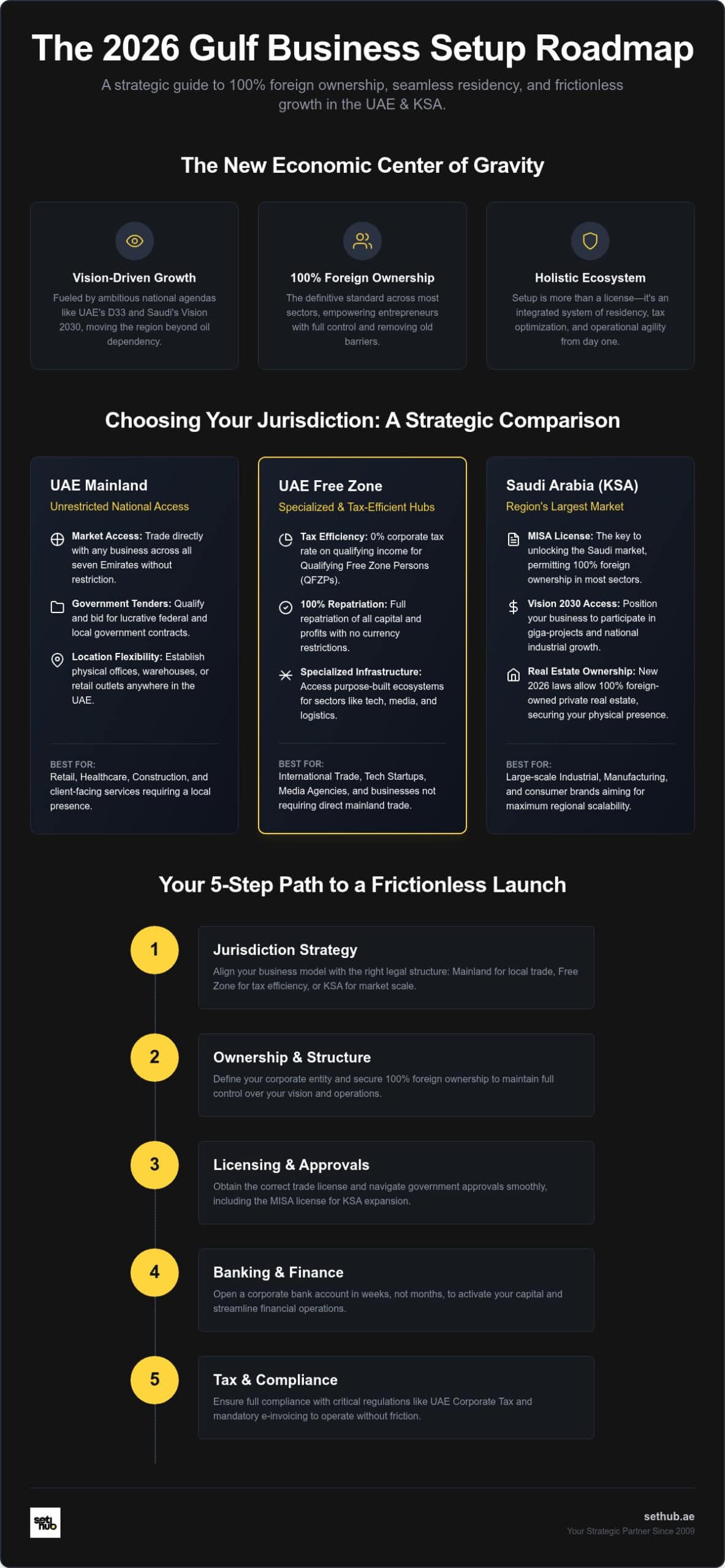
The 5-Step Roadmap to a Frictionless Business Launch
Launching a venture in a new market shouldn’t feel like a battle with bureaucracy. It’s a structured progression. A successful business setup follows a logical sequence that converts complex legal requirements into simple, manageable milestones. By following a proven roadmap, you can bypass common pitfalls and move from concept to operation with total confidence. For a comprehensive overview of this process, our guide on company formation in UAE walks you through every stage of the 2026 regulatory environment in detail.
- Step 1: Activity selection and legal structure determination. You must align your license with your operational reality to ensure long-term tax efficiency and regulatory compliance.
- Step 2: Trade name reservation and initial approvals. This step secures your brand identity and confirms that your proposed business meets the latest 2026 government standards.
- Step 3: Documentation and Memorandum of Association (MOA) drafting. We formalize the legal framework of your entity, ensuring shareholder rights and responsibilities are clearly defined.
- Step 4: License issuance and office space finalization. Your company becomes a legal person at this stage, paired with a registered address or Ejari to meet mandatory physical presence rules.
- Step 5: Visa processing and corporate bank account activation. We finalize your residency and unlock your financial operations, making the business fully ready to trade.
Securing Your Residency and Golden Visa
Long-term stability is the ultimate goal for any international investor. The golden visa uae offers a 10-year residency that removes the need for frequent renewals, allowing you to focus entirely on scaling your enterprise. Professional PRO services handle the heavy lifting of family and staff visa applications, ensuring your key personnel are on the ground and operational without delay. Residency isn’t just a permit; it’s the final piece of a sophisticated strategy that turns a legal necessity into a lifestyle asset.
Finalizing Your Office and HR Infrastructure
Your physical presence should evolve alongside your growth. Many founders start with Flexi-desks to minimize initial capital outlay. However, as you scale, transitioning to permanent corporate offices becomes necessary for both operational efficiency and team cohesion. If you’re looking at specific regional requirements, our business setup in ras al khaimah checklist provides a clear example of how local rules influence your office choice. Beyond the walls, recruitment support ensures you hire the right talent to drive your vision forward. Ready to begin? Use our business setup cost calculator to map out your 2026 expansion plan with total transparency.
Navigating Growth with Set Hub: Your Strategic Partner Since 2009
Success in the Gulf requires an insider’s perspective that only time and experience can provide. Since 2009, Set Hub has acted as a seasoned navigator for entrepreneurs entering the UAE and KSA markets. We’ve seen the regulatory landscape evolve firsthand over the last 17 years, adapting our strategies to every shift in policy and every new tax threshold. This longevity isn’t just a number. It represents over 10,000 success stories where we’ve transformed complex administrative hurdles into routine checkboxes. Choosing the right partner for your business setup means gaining a strategic ally who understands that your vision extends far beyond the initial launch. We prioritize your peace of mind by managing the friction of compliance so you can focus entirely on leadership and growth.
The Set Hub Advantage: End-to-End Excellence
We don’t just provide services; we curate the entire lifecycle of your expansion. Our approach consolidates Freezone and Mainland Company Formation, KSA Business Setup, and specialized Golden Visa Services into a single, managed flow. We intentionally eliminate the stress of dealing with multiple vendors for Corporate Tax registration, VAT compliance, or Corporate Bank Account Opening. By integrating these critical pillars, we ensure your transition is seamless and your operations are compliant from day one. This frictionless philosophy allows you to maintain entrepreneurial momentum while we handle the technical complexities of the local business environment. We act as your sophisticated facilitator, turning administrative milestones into simple steps on a strategic roadmap designed for long-term scalability.
Ready to Start Your Journey?
The path to market leadership in the UAE and KSA is wide open, but it demands precision and local expertise. You deserve the confidence that comes from expert guidance and a proven track record of reliability. Whether you’re a tech startup or a multinational firm, our team is ready to simplify your business setup and provide the HR, recruitment, and office space solutions necessary for long-term growth. Our team acts as a strategic partner for growth, ensuring that your company structure remains agile as you scale from a single office to a regional powerhouse. Don’t let administrative friction or opaque requirements stall your ambition. Take the first step toward a compliant, operational, and thriving future in the world’s most dynamic economic corridor. Use our Business Setup Cost Calculator or reach out for a tailored consultation to see how we can turn your expansion plans into a routine success.
Secure Your Future in the World’s Most Dynamic Economic Corridor
The regional shift toward 100% foreign ownership and integrated cross-border trade has made 2026 the definitive year for Gulf expansion. By now, you understand that a successful business setup requires more than just a license; it demands a strategic alignment of tax residency, corporate banking, and long-term compliance. Whether you choose the unrestricted reach of the UAE mainland or the industrial potential of KSA, your structure must be built for scalability from day one.
You don’t have to navigate these complexities alone. With over 10,000 businesses launched since 2009, we provide the seasoned expertise needed to turn regulatory hurdles into simple checkboxes. Our team handles everything from jurisdiction selection to full-service Corporate Tax and VAT compliance across both UAE and KSA territories. We ensure your transition is frictionless, allowing you to focus on what matters most: your growth.
Launch your business with Set Hub, the seasoned navigators of UAE and KSA company formation.
Your journey toward market leadership starts with a single, confident step. We’re here to ensure it’s a frictionless one. Let’s build your success together.
Frequently Asked Questions
What is the cost of business setup in the UAE for 2026?
Total first-year costs for a Dubai mainland business setup typically range from AED 38,000 to AED 100,000. This range includes the license fee, mandatory office space, initial approvals, and a single investor visa. Free zone options are often more accessible, with some specialized licenses starting near AED 4,888 excluding visas. Your final investment depends entirely on your specific activity and jurisdiction. It’s best to use a cost calculator to get a precise estimate for your plan.
Can a foreigner own 100% of a business in the UAE?
Yes, 100% foreign ownership is now the definitive standard for the majority of commercial and industrial activities in both the UAE and KSA. This landmark regulatory shift allows you to maintain full control over your operations and profits without needing a local majority shareholder. This change has transformed the business setup landscape, making the region significantly more attractive for international entrepreneurs who are seeking long-term stability and full operational autonomy.
How long does it take to get a trade license?
You can often obtain an initial approval for a trade license within 24 to 48 hours. The complete process, including trade name reservation and the issuance of the final license document, generally takes between five to ten working days depending on the chosen jurisdiction. While the administrative steps are fast, subsequent tasks like visa processing and corporate bank account activation require additional time. A managed flow ensures these milestones move forward without any unnecessary delays.
What is the difference between a Free Zone and a Mainland company?
Mainland companies can trade directly with the local UAE market and participate in government tenders without restrictions. In contrast, Free Zone companies are designed for international trade or sector-specific activities like tech or logistics. While Free Zones offer 100% profit repatriation and specific tax nuances, Mainland entities provide the flexibility to choose office space anywhere in the country. Your choice should align with your target audience and your five-year growth strategy.
Do I need a local partner to start a business in 2026?
You no longer need a local Emirati partner for most business activities on the UAE mainland. The requirement for a 51% local shareholder was removed for over 1,000 commercial and industrial activities. Some specific strategic sectors still require local participation, but the vast majority of entrepreneurs can now enjoy full ownership. This shift has simplified the business setup process, allowing you to focus on building your brand with complete independence and peace of mind.
How do I apply for a UAE Golden Visa through my new business?
You can apply for a UAE Golden Visa by meeting specific investment thresholds or by being categorized as an exceptional talent or entrepreneur. Once your company is established, you can leverage your status as a business owner to secure this 10-year residency for yourself and your family. The process involves a specialized medical test and Emirates ID application. This long-term visa provides the stability needed to scale your operations without the worry of frequent renewals.
What are the corporate tax requirements for new startups?
New startups are subject to a standard 9% corporate tax rate on taxable income exceeding AED 375,000. However, businesses with revenue of AED 3 million or less can claim Small Business Relief, exempting them from this tax until December 31, 2026. If you operate within a Free Zone as a Qualifying Person, you may also benefit from a 0% rate on qualifying income. Early registration is vital to ensure you remain compliant with the latest regulations.
Can I expand my UAE business into Saudi Arabia easily?
Expanding into Saudi Arabia is now a structured process thanks to the MISA investment license. This license allows UAE-based firms to establish 100% foreign-owned entities in the Kingdom. While there are specific capital requirements for sectors like retail, the overall regulatory alignment between the two nations has made cross-border growth much smoother. You can leverage your existing UAE infrastructure as a springboard to capture the massive opportunities presented by the KSA Vision 2030 initiative.
Need help with this? Set Hub’s consultants can help with company formation in Saudi Arabia. Book a consultation to get started.