


If 100% foreign ownership is now the standard for almost every business in the Emirates, why does the fze vs fzco vs llc difference still keep so many entrepreneurs awake at night? It’s a fair question. While the old barriers of local sponsorship have largely vanished, the choice you make today determines your tax liability under the 2026 9% corporate tax threshold and your ability to trade directly with customers across the broader UAE market.
We know the pressure of trying to build a foundation that won’t require a costly restructure in two years. You want a setup that feels frictionless; one that secures your residency and scales as fast as your ambitions. This definitive comparison eliminates the guesswork by mapping out exactly how each entity functions in the current regulatory environment.
We’ll explore the specific shareholder limits of Free Zone Establishments and Companies, the unrestricted market access of a Mainland LLC, and the latest visa quotas for 2026. By the end of this guide, you’ll have a clear, data-driven path to your trade license issuance without the typical administrative fatigue.
Key Takeaways
- Identify the right jurisdiction for your 2026 goals by understanding the updated 100% foreign ownership rules for both Mainland and Freezone entities.
- Master the fze vs fzco vs llc difference to choose between a single-shareholder setup or a multi-shareholder structure that supports long-term corporate governance.
- Determine your operational boundaries to decide if you need the unrestricted local market access of an LLC or the tax-optimized environment of a Freezone.
- Evaluate how each legal structure influences your residence visa eligibility and prepares your business for the 9% corporate tax threshold on income above AED 375,000.
- Streamline your path to a trade license by leveraging a frictionless setup process designed to move you from consultation to operation without administrative delays.
Understanding the Core Legal Entities in the UAE
Choosing your company structure is the most critical decision in your 2026 business plan. It’s the difference between a seamless scale-up and a bureaucratic bottleneck. While the UAE has simplified foreign ownership, the fze vs fzco vs llc difference remains the primary factor in how you access the market and manage your taxes. This choice dictates your operational ceiling before you even issue your first invoice. You aren’t just selecting a name; you’re choosing the legal framework that will govern your growth for the next decade.
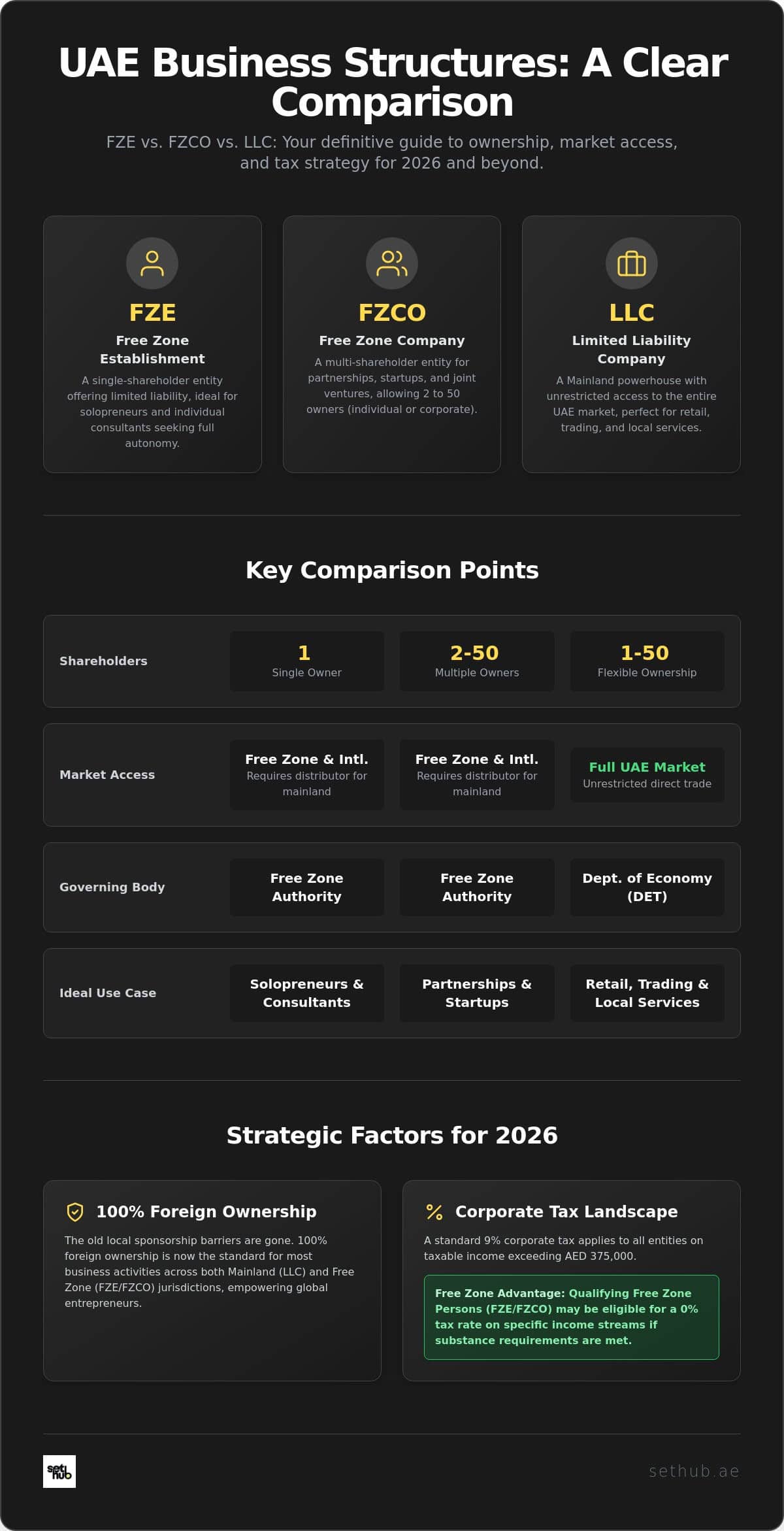
Governing bodies vary significantly by jurisdiction. Mainland companies fall under the Department of Economy and Tourism (DET) in their respective Emirate. Conversely, entities within UAE free zones are regulated by specific zone authorities, such as those in Sharjah, Ras Al Khaimah, or specific hubs in Dubai. These authorities set their own rules for capital, audits, and visa quotas. Your entity choice also determines your tax strategy. For 2026, the UAE applies a 9% corporate tax on income exceeding AED 375,000. However, Qualifying Free Zone Persons may still access a 0% rate on specific income if they meet strict substance requirements.
What is an FZE (Free Zone Establishment)?
An FZE is a single-shareholder entity. It’s a popular choice because it’s treated as a separate legal person from its owner, protecting your personal assets. If you’re a solopreneur or a consultant looking for a lean, efficient setup, this is your go-to structure. It provides a professional corporate identity without the need for partners or complex board meetings. It’s the ultimate vehicle for individual entrepreneurs who want total autonomy while maintaining limited liability.
What is an FZCO (Free Zone Company)?
An FZCO is the multi-shareholder version of a freezone entity. Often referred to as an FZ-LLC, it allows for two to 50 shareholders. This flexibility is vital for startups with co-founders or international corporations establishing a regional subsidiary. Understanding the fze vs fzco vs llc difference here is simple; it’s about the number of people on the license and the governance structure you need to support them. It allows for a mix of individual and corporate owners, providing a robust platform for shared investment.
What is an LLC (Limited Liability Company)?
A Mainland LLC is the powerhouse of UAE business. Registered with the DET, it grants you the right to trade anywhere in the UAE, including direct sales to the public and government entities. While freezone companies are generally restricted to their zone or international markets, an LLC has no geographic boundaries within the country. It’s the gold standard for retail, construction, and local service providers targeting the domestic market. With 100% foreign ownership now available for most activities, it has become a primary choice for global firms.
For entrepreneurs looking at specialized sectors, you can visit Auto Industries Factory LLC to see an example of a vehicle fabrication specialist that leverages the advantages of a UAE-based operation.
Your choice impacts your ability to trade locally. Freezone entities often require a local distributor or a separate mainland branch to sell goods onshore. By contrast, an LLC allows you to operate with total freedom across all seven Emirates. As a seasoned navigator of this landscape, we see that the right choice today prevents the friction of a costly restructure tomorrow. Each structure offers specific advantages depending on whether your target audience is local, regional, or global.
Shareholder Structures: FZE vs FZCO Comparison
Your ownership structure is the engine of your business. In the UAE’s evolving regulatory landscape, the fze vs fzco vs llc difference is most visible in how you manage your boardroom and equity. While both freezone entities offer a shield of limited liability, the number of people or companies at the table changes your administrative responsibilities. Choosing the right path now prevents the friction of a mandatory restructure as you scale.
Solo Founders vs. Partnerships
An FZE is the pinnacle of administrative simplicity. Designed for a single owner, it allows you to maintain total control without the need for board meetings or complex shareholder agreements. It’s the preferred choice for consultants and digital nomads who value speed and autonomy. However, if your vision involves co-founders or corporate investors, the FZCO is the correct vehicle. An FZCO typically supports between two and 50 shareholders, making it the standard for joint ventures and startups preparing for future funding rounds.
This structure allows for a mix of individual and corporate shareholders, which is a detail often highlighted in any comprehensive global business owner’s guide to the region. Unlike the solo FZE, an FZCO requires a more formal governance approach, often involving the appointment of a Board of Directors to oversee operations and protect the interests of all partners.
Capital Requirements and Liability
Minimum share capital requirements are no longer the barrier they once were. Most modern free zones allow you to register your company without an immediate capital deposit, though specific regulated activities may still require a minimum amount, such as AED 50,000 or AED 100,000, depending on the zone’s internal bylaws. Regardless of the amount, the legal protection remains absolute. While an FZE is designed for individual entrepreneurs, it still offers the same robust corporate protection as a multi-member entity. This means your personal assets stay separate from the company’s liabilities, providing the peace of mind necessary to take calculated risks.
As your venture grows, you aren’t locked into your initial choice. Converting an FZE into an FZCO is a standard procedure that involves amending your Memorandum of Association to add new shareholders. This flexibility ensures that your legal structure evolves alongside your revenue. If you’re ready to see how these structures impact your bottom line, our Business Setup Cost Calculator provides an instant breakdown of the fees involved for each entity type. Understanding this fze vs fzco vs llc difference early on ensures you don’t overcomplicate your governance before it’s necessary, allowing you to focus on growth rather than paperwork.
The Operational Divide: Freezone Entities vs. Mainland LLC
Where you trade is as important as what you sell. The fze vs fzco vs llc difference isn’t just a legal footnote; it’s a map of your market reach. Freezone entities are essentially “offshore” when it comes to the local UAE market. They’re designed for international trade or business within the zone’s boundaries. If you want to sell products directly to a customer in a Dubai mall or bid for a government contract in Abu Dhabi, a Mainland LLC is your only direct route.
Geographical Trade Restrictions
Freezone companies face a hard legal boundary. To sell goods onshore, you must typically appoint a local distributor or open a separate mainland branch. This adds a layer of complexity and cost. A Mainland LLC removes these barriers entirely. It grants you the freedom to trade B2C and B2B across all seven Emirates without intermediaries. This unrestricted access is why 2026 is becoming the year of the ‘Mainland expansion’ for foreign firms looking to capture a slice of the UAE’s projected 5.6% GDP growth. Businesses are moving onshore to stay closer to their customers and eliminate the friction of third-party distribution; as you establish your local presence, you can discover The Solution for specialized damage repair and restoration services.
Ownership and Sponsorship Evolution
The fear of losing control used to drive founders toward Freezones. That’s no longer the case. In 2026, 100% foreign ownership is the standard for most Mainland activities. You don’t need a local partner for typical commercial or industrial licenses. A UAE National is only legally required for strategic sectors like oil and gas or defense. For everything else, you retain full equity and decision-making power. We help entrepreneurs manage this transition through a streamlined Mainland company formation process that treats legal milestones like simple checkboxes. This evolution has balanced the playing field, making the fze vs fzco vs llc difference more about your target audience than about ownership rights.
Physical presence also differs between these structures. Mainland licenses usually require a physical office with a verified Ejari, which is a registered tenancy contract. Many Freezones are more flexible, offering virtual offices or flexi-desks that are perfect for lean startups. This makes Freezones an attractive entry point for digital businesses, while the LLC is the superior choice for those needing a significant local footprint and retail presence. For example, specialized retailers like Budget Gamer UAE demonstrate the importance of selecting a structure that supports a dedicated physical location to serve a tech-focused market. Choosing correctly today ensures you don’t rent more space than your license requires or limit your trade reach before you’ve even started.
Strategic Selection Criteria: Visas, Taxes, and Costs
Success in the UAE depends on looking beyond the initial setup fee. While a low entry cost is attractive, the fze vs fzco vs llc difference truly reveals itself during your first annual renewal and your first tax filing. Your choice determines your recurring overhead, your ability to sponsor talent, and your eligibility for long-term residency. A strategic decision today ensures your capital remains focused on growth rather than administrative maintenance.
Visa Eligibility and Quotas
Your visa quota is your growth limit. In most free zones, an FZE or FZCO package comes with a fixed number of residency slots, often ranging from one to six depending on your desk or office type. If you plan to scale a large team quickly, a Mainland LLC offers superior flexibility. On the mainland, your visa quota is primarily linked to the size of your physical office space, typically allowing for one visa per nine square meters of area.
For high-net-worth founders and specialized talent, business setup is often the first step toward Golden Visa eligibility. This ten-year residency provides unparalleled stability and removes the need for frequent renewals. Whether you choose a Freezone or Mainland structure, aligning your license with your long-term residency goals is a checkbox we help you tick early in the process.
Corporate Tax and VAT Compliance in 2026
The fiscal landscape has changed. For the 2026 tax period, all entities face a 9% corporate tax on taxable income exceeding AED 375,000. To manage this transition, many entrepreneurs rely on IBR Group for specialized corporate tax registration and auditing. While Freezone companies can potentially access a 0% rate as a Qualifying Free Zone Person, the requirements for “Qualifying Income” are strict and require robust economic substance. Mainland LLCs don’t have these specific “Qualifying” hurdles but benefit from a straightforward 0% rate on all profit below the AED 375,000 threshold.
VAT registration also follows a clear trajectory. Once your taxable turnover hits AED 375,000, registration is mandatory, regardless of your license type. Voluntary registration is available at AED 187,500, which is often a smart move for businesses wanting to reclaim VAT on setup expenses. Managing these milestones is part of our frictionless approach to corporate support, and you can discover AccouConsult for specialized tax and advisory solutions that complement your setup.
Your license type also dictates your experience with local financial institutions. Corporate bank account opening is generally more straightforward for Mainland LLCs due to their perceived local “substance.” Freezone entities may face more rigorous compliance checks, though these are easily managed with the right documentation. If you want to compare the specific fees for each structure, use our Business Setup Cost Calculator to get an instant, transparent breakdown of your projected investment. Understanding the fze vs fzco vs llc difference in this context ensures you aren’t surprised by hidden costs during your second year of operation.
Navigating Your Setup with Set Hub
Success in the UAE market requires more than just picking a license. It demands a partner who understands the local landscape and can execute your vision without the typical administrative friction. Since 2009, Set Hub has acted as a seasoned navigator for over 10,000 entrepreneurs. We don’t just explain the fze vs fzco vs llc difference; we build the legal and operational framework that allows your business to thrive from day one. Our team handles the heavy lifting so you can focus on your market entry strategy and B2B outreach, utilizing expert insights from virtual-sales.com to scale effectively in 2026.
End-to-End Licensing Support
Securing 100% foreign ownership is a milestone, but the documentation must be flawless to protect your interests. We specialize in fast-tracking trade license issuance across all UAE jurisdictions, ensuring your legal structure is compliant with the latest 2026 regulations. Whether you’re establishing a solo consultancy or a multi-shareholder corporation, we manage the entire lifecycle of your application. Set Hub excels at consolidating multiple complex administrative tasks into a single, managed flow that prioritizes your peace of mind. This integrated approach eliminates the need to coordinate between different government departments or service providers.
Beyond Registration: Scaling Your Business
A trade license is the foundation, but your business needs momentum to grow. We provide comprehensive corporate support that extends far beyond the initial setup. This includes:
- Corporate Bank Account Opening: We leverage our relationships with local and international banks to simplify the compliance and KYC process for new entities.
- Office Space Solutions: From premium executive suites to cost-effective flexi-desks, we find spaces that align with your visa requirements and budget.
- Residency and Visa Management: We handle the entire residency process for founders and employees, including medical tests and Emirates ID registration.
- VAT and Tax Compliance: Our experts ensure you’re registered for Corporate Tax and VAT, helping you manage the 9% threshold and avoid costly penalties.
Beyond these administrative steps, establishing a robust digital presence is vital for any new venture. Companies often work with Shark Matrix Technologies LLC to develop custom software and digital marketing strategies that ensure they stand out in the competitive Dubai market.
The fze vs fzco vs llc difference ultimately comes down to how you want to trade and grow. We ensure your choice today doesn’t limit your opportunities tomorrow. By managing your PRO services, accounting, and ongoing renewals, we act as your strategic partner for long-term success. Ready to start? Get a personalized business setup consultation today.
Ready to Secure Your Future in the UAE?
Selecting your legal structure is more than an administrative hurdle; it’s a strategic launchpad. Whether you opt for the solo-founder efficiency of an FZE, the partnership flexibility of an FZCO, or the total market reach of a Mainland LLC, your choice shapes your growth trajectory in 2026. Understanding the fze vs fzco vs llc difference ensures you align your business with the right tax benefits and visa quotas from the very beginning.
The path to a successful trade license doesn’t have to be complex. Since 2009, we’ve helped 10,000+ entrepreneurs navigate the intricacies of Mainland and Freezone setups across all seven Emirates. From initial licensing to expert Golden Visa and residency solutions, we provide the seasoned navigation you need to move forward with total confidence.
You deserve a setup process that feels frictionless. Let us handle the regulatory weight so you can focus on building your legacy in the UAE. Start your frictionless UAE business setup with Set Hub today. Your future in one of the world’s most dynamic markets is waiting.
Frequently Asked Questions
What is the main difference between an FZE and an FZCO?
The primary distinction lies in the number of shareholders allowed under the license. A Free Zone Establishment (FZE) is designed for a single shareholder, making it the ideal choice for solo founders and consultants. A Free Zone Company (FZCO) allows for multiple shareholders, typically between two and 50. While both structures provide limited liability protection, the choice depends on whether you’re launching a solo venture or a partnership.
Can an LLC be 100% foreign-owned in the UAE in 2026?
Yes, 100% foreign ownership is the current standard for the vast majority of mainland business activities. As of 2026, the previous requirement for a local sponsor has been removed for most commercial and industrial licenses. You retain full equity and decision-making power over your company, although a few strategic sectors, such as oil and gas, still require a UAE National partner.
Which structure is cheaper: Freezone or Mainland LLC?
Freezone licenses are generally more cost-effective for initial setup, particularly for digital businesses that don’t require physical premises. Some zero-visa packages in the Northern Emirates start as low as AED 4,888. A Mainland LLC typically involves a higher initial investment, often ranging from AED 25,000 to AED 40,000, because it requires a physical office and additional registration fees with the Department of Economy.
Can I change my FZE to an FZCO later on?
You can certainly convert an FZE into an FZCO as your business expands. This process involves amending your Memorandum of Association to add new shareholders and updating your trade license with the relevant Free Zone Authority. This flexibility is a vital part of the fze vs fzco vs llc difference, ensuring your legal structure can scale seamlessly alongside your revenue and team growth.
How many visas can I get with an FZE license?
The number of residency visas depends on the specific free zone and the type of facility you lease. A standard flexi-desk package usually provides between one and three visa slots. If you need to sponsor a larger team, you’ll typically need to upgrade to a physical office space, where the quota is determined by the total square footage of your unit.
Do Freezone companies have to pay corporate tax in 2026?
Freezone companies are subject to a 9% corporate tax on taxable income that exceeds AED 375,000. However, your business may still qualify for a 0% tax rate on “Qualifying Income” if it meets the strict requirements of a Qualifying Free Zone Person. This involves maintaining adequate economic substance and ensuring your activities fall within the government’s approved list of qualifying sectors.
Can an FZCO trade directly with Mainland companies?
Freezone entities are legally restricted from trading directly with the UAE mainland without an intermediary. To sell goods or services onshore, you must either appoint a local distributor or establish a separate mainland branch. This operational boundary is a fundamental fze vs fzco vs llc difference that often makes a Mainland LLC the preferred choice for businesses targeting the domestic UAE market.
What are the capital requirements for an LLC?
Most Mainland LLCs in the UAE do not have a fixed minimum paid-up share capital requirement for standard commercial activities. The law generally requires that the capital be “sufficient” to achieve the company’s stated objectives. While you must declare a share capital amount in your legal documents, you aren’t typically required to deposit this amount into a bank account during the initial registration phase.
Need help with this? Set Hub’s consultants can help with mainland company setup. Book a consultation to get started.