


In 2026, launching a business in the Emirates is no longer just about getting a piece of paper. It’s about strategic positioning in a mature global market. You’ve likely realized that company formation in uae has evolved into a more sophisticated process. It’s a landscape now defined by specific corporate tax thresholds and new e-invoicing requirements. It’s natural to feel some anxiety when weighing the merits of a Free Zone against a Mainland setup or navigating the nuances of modern banking compliance. You want to focus on your vision, not get stuck in administrative hurdles.
We understand that your priority is a frictionless path to growth. This guide provides the expert clarity you need to master the 2026 regulatory environment. You’ll discover how to secure a compliant trade license rapidly, lock in long-term residency through the Golden Visa, and manage the 9% corporate tax landscape with total confidence. We’re moving from confusion to a seamless, high-speed setup that puts you in the driver’s seat of your entrepreneurial future. By the end of this roadmap, you’ll have a clear, actionable strategy to turn regulatory complexity into a competitive advantage.
Key Takeaways
- Identify the strategic differences between Mainland and Free Zone structures to ensure your business has the right market access from day one.
- Follow a proven five-step roadmap for company formation in uae that simplifies trade name reservation and avoids early administrative delays.
- Prepare for the 2026 corporate tax regime and VAT requirements with a clear plan for financial compliance and corporate banking setup.
- Leverage the latest Golden Visa criteria to transition from a business owner to a long-term resident with full family sponsorship benefits.
- Learn how a managed approach to licensing and office space can eliminate regulatory friction and accelerate your time to market.
Navigating the UAE Business Landscape: Mainland vs. Free Zone Structures
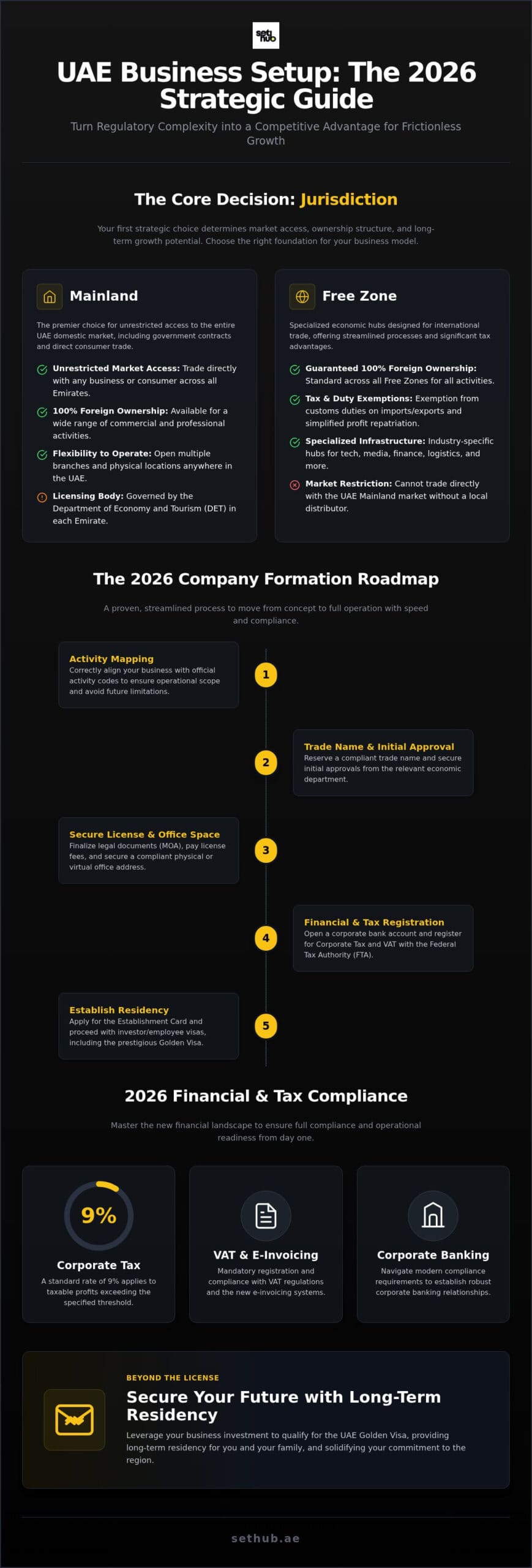
The single most consequential decision in your company formation in UAE journey isn’t your trade name or your office address. It’s your jurisdiction. Get this choice right, and everything that follows becomes significantly more straightforward. Get it wrong, and you’ll face costly restructuring down the line. Understanding UAE Corporate Law reveals a landscape built on three distinct jurisdictions, but for most entrepreneurs in 2026, the strategic choice comes down to two: Mainland or Free Zone.
Mainland Companies: Accessing the National Market
A Mainland license, issued through the Department of Economy and Tourism (DET), gives your business unrestricted access to the UAE’s national market. There are no geographic limitations on where you can trade, who you can serve, or how many locations you can operate. This makes it the clear preference for retail operators, local service providers, and any business whose revenue depends on direct consumer or government contracts.
A critical evolution worth understanding: the UAE’s 2021 Commercial Companies Law amendments opened 100% foreign ownership to a broad range of commercial activities on the Mainland, eliminating the historic requirement for a local Emirati sponsor in most sectors. This was a structural shift, not a minor update. Certain strategic sectors still carry specific ownership conditions, so verifying your activity category during the registration process remains essential.
Free Zone Entities: Specialized Hubs and 100% Ownership
Free Zones were purpose-built for focus. Whether it’s technology, media, logistics, or financial services, each zone is engineered to attract a specific business cluster and offer a curated regulatory environment to match. The core advantages are well-established:
- 100% foreign ownership: Guaranteed across all Free Zones, with no exceptions.
- Customs duty exemptions: Goods moving through a Free Zone for re-export are generally exempt, making these structures highly efficient for international trade operations.
- Simplified repatriation: Profits and capital can typically be repatriated without restriction.
- Designated Zone status: Certain Free Zones hold “Designated Zone” classification for VAT purposes, meaning specific goods transactions within them may be treated as outside the UAE for VAT, which carries meaningful implications for supply chain planning.
The trade-off is market access. A Free Zone entity cannot directly trade with the UAE Mainland market without either appointing a local distributor or obtaining a separate Mainland license. For businesses focused purely on international clients or digital services, this restriction is largely irrelevant. For those with mixed market ambitions, a dual-license strategy is worth evaluating early.
Matching your business activity to the right jurisdiction is the foundation of smart company formation in UAE. The right structure doesn’t just satisfy a regulatory requirement; it actively supports your growth model from the first day of trading.
The 2026 Roadmap to Company Formation in UAE
Launching a business in the Emirates is a sequence of strategic wins rather than a mere administrative task. The process for company formation in uae has become increasingly streamlined, reflecting the high rankings found in the World Bank’s Doing Business report regarding regulatory efficiency. While the government has digitized many steps, success still depends on the precision of your initial filings. A single error in activity mapping can lead to delays or restricted operational scope later on.
Activity Mapping and Trade Name Reservation
Your first priority is correctly aligning your business activities with the official classifications. The UAE uses a standardized system to categorize thousands of commercial, industrial, and professional activities. You’ll need to select the codes that best match your intended operations. Choosing too many can increase your license fees, while choosing too few might prevent you from bidding on specific contracts. It’s a balance that requires foresight.
Once your activities are set, you’ll reserve your trade name. The rules are specific: names cannot include religious references, political affiliations, or names of existing global brands. If you’re using your own name, it must be your full name without initials. Following name approval, you’ll receive an Initial Approval certificate. This is a vital document; it signals that the government has no objection to your business and allows you to proceed with lease agreements and legal drafting.
Selecting the Correct Legal Form
Your legal structure dictates your liability, tax obligations, and future scalability. A Limited Liability Company (LLC) is the most common vehicle for foreign investors in 2026. For individual entrepreneurs, a Sole Establishment offers simplicity but lacks the asset protection of an LLC. International firms often weigh the benefits of a branch office versus a subsidiary. A branch acts as an extension of the parent company, while a subsidiary is a distinct legal entity with its own independent liability.
The final phase involves drafting the Memorandum of Association (MOA). This document is the bedrock of your company, outlining ownership percentages and management powers. In 2026, most MOAs are signed electronically, accelerating the timeline to your final license. To see how these structural choices impact your initial investment, you can use our business setup cost calculator for an instant, transparent breakdown. Modern systems ensure that company formation in uae is faster than ever, provided your documentation is flawless from the start.
- Step 1: Define business activities and legal structure.
- Step 2: Secure trade name and Initial Approval.
- Step 3: Register an office address and attest the lease.
- Step 4: Draft and notarize the Memorandum of Association.
- Step 5: Pay license fees and collect your trade license.
Financial Readiness: Corporate Tax, VAT, and Banking Compliance
Securing your trade license is a major milestone, but the financial infrastructure you build next determines your company’s long-term viability. In 2026, the financial landscape for company formation in uae is more structured than ever. While the tax environment remains highly competitive on a global scale, compliance is now a mandatory pillar of business operations. You don’t just need a license; you need a robust financial setup that satisfies both federal regulators and international banking standards.
Navigating the 2026 UAE Corporate Tax Regime
The UAE’s transition to a federal corporate tax system is now fully mature. Businesses are subject to a standard rate of 9% on taxable income exceeding AED 375,000. If your taxable income stays below this threshold, a 0% rate applies, providing significant relief for startups and small enterprises. However, even if you fall into the 0% bracket, you’re still required to register for corporate tax and maintain accurate financial records. Failure to register within the government-mandated deadlines can result in steep administrative penalties.
Value Added Tax (VAT) also remains a critical consideration. If your annual turnover exceeds AED 375,000, VAT registration is mandatory. For businesses with turnover between AED 187,500 and AED 375,000, voluntary registration is an option that can help you recover input tax on business expenses. To understand your specific liabilities and plan your cash flow effectively, consult our VAT Calculator UAE: A Comprehensive Guide to 2026 Tax Compliance. Keeping compliant financial records from day one isn’t just about following the law; it’s about making your business “bankable” for future growth.
Streamlining Corporate Bank Account Opening
Banking remains the most significant bottleneck for international founders during company formation in uae. Local and international banks have rigorous Know Your Customer (KYC) procedures designed to prevent money laundering and ensure transparency. You’ll need to provide comprehensive documentation, including your trade license, MOA, and proof of residency. Banks also look for “substance,” which often means showing a physical office lease or a clear business plan that justifies your presence in the country.
Digital-first banking solutions like Wio have significantly improved the onboarding experience for new entrepreneurs. These platforms offer faster approvals and more intuitive interfaces than traditional legacy banks. However, regardless of the platform you choose, having a seasoned navigator to review your documentation before submission is essential. A single missing document or a vague business description can lead to a rejected application, forcing you to start the process from scratch. Proper accounting and regular auditing aren’t just administrative burdens; they’re the credentials that prove your business is a reliable partner in the UAE’s thriving economy.
Beyond the License: Residency, Visas, and Human Capital
Once the foundation of your company formation in uae is laid, your focus shifts to your most valuable asset: yourself and your team. A trade license is the legal key, but a residency visa is what allows you to truly unlock the lifestyle and professional benefits of the Emirates. This transition from business owner to resident involves a specific lifecycle. It starts with an entry permit and concludes with your Emirates ID and medical clearance. It’s a process designed for efficiency, yet it requires precise timing to ensure your legal status remains uninterrupted as you move from your home country to your new headquarters.
Securing the UAE Golden Visa and Residency
For those seeking long-term stability, the 10-year Golden Visa is the gold standard for entrepreneurs. In 2026, you can qualify through a public investment of at least AED 2 million. This visa removes the need for a local sponsor and allows for full family sponsorship, including spouses and children of any age. If your investment is real-estate focused, it’s worth noting that the previous AED 750,000 minimum property value for sole owners has been removed. However, for jointly owned properties, each investor must still have a minimum share of AED 400,000. These changes reflect a trend toward making the region more accessible to a broader range of international investors. To explore the full spectrum of eligibility, read The Ultimate Guide to the UAE Golden Visa in 2026: Requirements, Benefits, and Application.
PRO Services and Document Clearing
Managing human capital requires staying ahead of Ministry of Human Resources & Emiratisation (MOHRE) regulations. Every company formation in uae comes with a specific visa quota based on your office space and license type. Navigating labor contracts, medical checks, and Emirates ID applications can be a source of significant friction if you handle it alone. This is where professional PRO services become indispensable. These experts act as your “Seasoned Navigator,” liaising with government departments to ensure every document is cleared without you ever needing to stand in a queue.
PRO support also covers complex payroll requirements. This includes managing social security contributions, which currently stand at 20% for UAE national employees outside of Abu Dhabi. A dedicated partner ensures you remain compliant with the latest Emiratisation targets and labor law updates as you scale your workforce. If you’re ready to secure your long-term future and bypass the administrative hurdles, our team can fast-track your Golden Visa services today. We treat these administrative milestones not as hurdles, but as simple checkboxes on your path to success.
Achieving Frictionless Growth with Expert Business Setup Consultants
Attempting a DIY approach to company formation in uae might seem cost-effective initially, but the hidden risks of minor administrative errors often lead to expensive rejections. In a regulatory environment that now includes mature corporate tax frameworks and mandatory e-invoicing, the role of a Sophisticated Facilitator is no longer a luxury. It’s a strategic necessity. By partnering with a seasoned navigator, you shift the administrative heavy lifting away from your desk. This allows you to focus entirely on your market entry and revenue growth while we handle the technicalities.
Why a Strategic Partner is Essential in 2026
The 2026 business landscape demands more than just a trade license; it requires a deep understanding of jurisdictional alignment and long-term compliance. Experts provide the insider knowledge needed to navigate the latest Ministry updates and banking shifts without the typical friction. We ensure your documentation is perfect the first time, preventing the delays that often plague self-filed applications. For a broader perspective on regional expansion, you can explore The Comprehensive Business Setup Guide: Launching Your Success in the UAE and KSA (2026). Our team acts as an extension of your business, turning regulatory hurdles into simple checkboxes on your path to success.
Comprehensive Corporate Support Services
We consolidate every moving part of your launch into a single, managed flow. This isn’t just about registration. It’s about providing a complete ecosystem for your business. From finding the right office space solutions to managing your ongoing VAT filing and corporate tax registration, we provide end-to-end care that prioritizes your peace of mind. We simplify the complexities of company formation in uae so you can start trading with confidence.
Transparency is the bedrock of our partnership. You can use our Business Setup Cost Calculator to get an immediate, data-driven breakdown of your projected investment. This ensures there are no surprises as you scale. Set Hub has assisted over 10,000 entrepreneurs in achieving their business goals. Since 2009, we’ve acted as a strategic partner for founders from every corner of the globe. We don’t just set up companies; we build the foundations for long-term entrepreneurial growth in the Emirates.
Your Future in the Emirates Starts Today
Success in 2026 requires a shift from simply obtaining a license to building a compliant, scalable corporate structure. Choosing the right jurisdiction between Mainland and Free Zone creates the foundation for your growth. By mastering the tax landscape and securing long-term residency, you transform administrative hurdles into competitive advantages. Modern company formation in uae shouldn’t be a source of friction; it’s the first checkbox on your path to global success.
We’ve served over 10,000 entrepreneurs since 2009 and helped them navigate this landscape with absolute confidence. From expert assistance with corporate bank account opening to specialized Golden Visa and PRO support, we handle the complexities while you focus on your vision. It’s time to move from planning to execution with a partner who understands every nuance of the local environment. Launch your UAE business with ease; get a personalized consultation from Set Hub today. Your entrepreneurial journey is ready for its most ambitious chapter yet.
Frequently Asked Questions
How much does company formation in UAE cost in 2026?
Setup costs vary based on your jurisdiction and specific business activities. For a mainland company, initial trade license fees generally range between AED 10,000 and AED 20,000. When you factor in office space and administrative fees, total first-year costs typically sit between AED 25,000 and AED 55,000. Some free zones offer more affordable entry points with basic licenses starting near AED 5,750. It’s best to use a specialized calculator for a tailored estimate.
Can a foreigner own 100% of a company in the UAE?
Foreign investors enjoy 100% ownership of their businesses in both Mainland and Free Zone jurisdictions. The 2021 amendments to the Commercial Companies Law removed the requirement for a local Emirati partner in most commercial and industrial sectors on the Mainland. Free Zones have always offered this benefit. This shift makes company formation in uae much more attractive for international entrepreneurs looking for full control over their operations and capital.
How long does it take to get a trade license in the UAE?
You’ll typically obtain a trade license within 5 to 10 working days once your documentation is submitted correctly. Some Free Zones offer instant licenses that can be processed in as little as 24 hours for specific activities. The timeline often depends on how quickly you secure initial approvals and trade name reservations. Ensuring your paperwork is flawless from the start is the most effective way to prevent administrative delays during the process.
What is the difference between a Mainland and a Free Zone license?
The primary difference lies in market access and geographic operational limits. A Mainland license allows you to trade anywhere within the UAE and bid on government contracts without restrictions. Free Zone licenses are designed for companies focusing on international trade or specific industry niches. While Free Zones offer specialized infrastructure and customs duty exemptions, they generally require a local distributor or a separate Mainland branch to sell goods directly into the local market.
Is it mandatory to have a physical office for a UAE company?
A physical office space is generally a mandatory requirement for Mainland companies to secure an Ejari tenancy contract. This document is essential for license issuance and visa processing. Many Free Zones offer more flexible alternatives, such as flexi-desks or smart offices, which satisfy the legal requirement for a registered address at a lower cost. Your choice depends on your headcount and whether you need a dedicated space to meet clients or store inventory.
How do I apply for a UAE Golden Visa as a business owner?
Business owners can apply for a 10-year Golden Visa by meeting specific investment thresholds. The most common route is a public investment of at least AED 2 million or owning a property of equivalent value. You’ll need to submit your trade license, audited financial statements, and proof of investment to the relevant immigration authorities. This residency status provides long-term stability and allows you to sponsor your family and domestic staff without a local employer.
Do I need a local sponsor for my UAE business in 2026?
You don’t need a local sponsor for the vast majority of business activities in 2026. The requirement for a UAE national to hold 51% of shares has been abolished for most commercial and industrial licenses on the Mainland. Certain strategic sectors, such as oil and gas or defense, may still have specific ownership conditions. For most entrepreneurs, this means you retain full legal and operational authority over your company from the first day.
What are the Corporate Tax requirements for new UAE companies?
New companies must register for Corporate Tax and follow the 9% standard rate on taxable income exceeding AED 375,000. If your taxable income remains below this threshold, a 0% rate applies. Even if you fall into the 0% bracket, you’re still required to file annual tax returns and maintain compliant financial records. This mature tax regime ensures your company formation in uae is built on a transparent financial foundation that aligns with global standards.
Need help with this? Set Hub’s consultants can help with estimate your business setup cost. Book a consultation to get started.