


Could a simple math error in an Excel sheet really cost your business a fixed AED 10,000 penalty or the new 14% annual late payment charge? In the current UAE tax landscape, the distance between a successful filing and a costly FTA violation is often just a few misplaced decimal points. It’s natural to feel a sense of friction when distinguishing between zero-rated and exempt supplies, especially with the 2026 updates regarding reverse charge mechanisms and the five-year limit on carrying forward input VAT.
You deserve a financial process that feels like a strategic advantage rather than a regulatory hurdle. By utilizing a precise vat calculator and mastering the underlying formulas, you can eliminate manual errors and gain total clarity over your tax obligations. This guide provides everything you need to navigate the mandatory AED 375,000 registration threshold, understand the latest penalty structures effective from April 2026, and maintain audit-ready documentation. We’ll move quickly from technical confusion to actionable confidence, ensuring your business remains compliant while you focus on growth.
Key Takeaways
- Master the precise formulas to add or subtract tax from any transaction, ensuring your financial records are always audit-ready.
- Simplify your accounting and eliminate manual entry errors by integrating a professional vat calculator into your daily workflow.
- Determine exactly when to register for a TRN by understanding the latest mandatory and voluntary thresholds for 2026.
- Protect your profit margins by learning how to correctly document input and output tax for maximum recovery.
- Discover how professional tax registration can transform a complex legal requirement into a seamless milestone for your business growth.
Understanding the UAE VAT Landscape in 2026
VAT isn’t just a tax; it’s a pillar of the UAE’s modern economic framework. Since its introduction in 2018, the standard 5% rate has become a routine part of business operations across the Emirates. By 2026, this system has matured into a sophisticated tool for economic diversification, moving the nation toward a future less dependent on oil revenue. For entrepreneurs, staying compliant means more than just paying a bill. It’s about maintaining a clean standing in a market that prioritizes transparency and digital accuracy.
The system of Taxation in the United Arab Emirates is designed to be efficient, but it leaves little room for error. Every transaction requires precision to ensure your records align with federal requirements. Integrating a vat calculator into your weekly accounting routine helps you stay on the right side of the law while keeping your cash flow predictable. Accuracy is vital because the Federal Tax Authority (FTA) views incorrect filings as a serious compliance gap, which can lead to significant administrative hurdles for your growing company.
The Role of the Federal Tax Authority (FTA)
The FTA is the guardian of the UAE’s tax ecosystem. Their mandate extends beyond simple collection; they enforce a framework that ensures market fairness. In 2026, this enforcement is almost entirely digital. The EmaraTax platform serves as the central hub for all filings, registrations, and payments. The FTA monitors business compliance through these electronic records, making it easier for them to spot discrepancies. If your records don’t match your filings, the authority’s automated systems will flag the error, often leading to an audit or immediate penalties.
Standard Rate vs. Zero-Rated vs. Exempt
Confusion between tax categories is where most financial friction begins. Not every transaction carries the 5% charge, and misclassifying a sale can result in incorrect tax returns. Understanding these distinctions is the first step toward a frictionless audit experience:
- Standard Rate (5%): This applies to most local goods and services, including electronics, cars, and professional services.
- Zero-Rated (0%): This includes international transport, certain healthcare services, and exports to countries outside the GCC. While the tax rate is 0%, you must still document these sales and can claim back the VAT paid on your business expenses.
- Exempt: Certain financial services and residential land are exempt from VAT. Unlike zero-rated supplies, you cannot claim back the VAT you paid on expenses related to these exempt activities.
Using a vat calculator that allows you to toggle between these rates ensures your invoices are always correct. This clarity protects your profit margins and ensures you aren’t overpaying or under-collecting tax on behalf of the government.
How to Calculate VAT: Manual Formulas and Excel Methods
Precise accounting gives you peace of mind. It transforms a mandatory task into a clear view of your business health. While many entrepreneurs use a digital vat calculator for speed, understanding the underlying math ensures you can verify your records at a glance. Mastering these formulas allows you to manage your cash flow with confidence, ensuring you always know how much of your bank balance belongs to the business and how much is held in trust for the government.
The Standard VAT Formulas
Calculating the 5% rate is straightforward if you use the right logic. Whether you’re preparing a quote or reconciling a purchase, these three formulas are your essential tools:
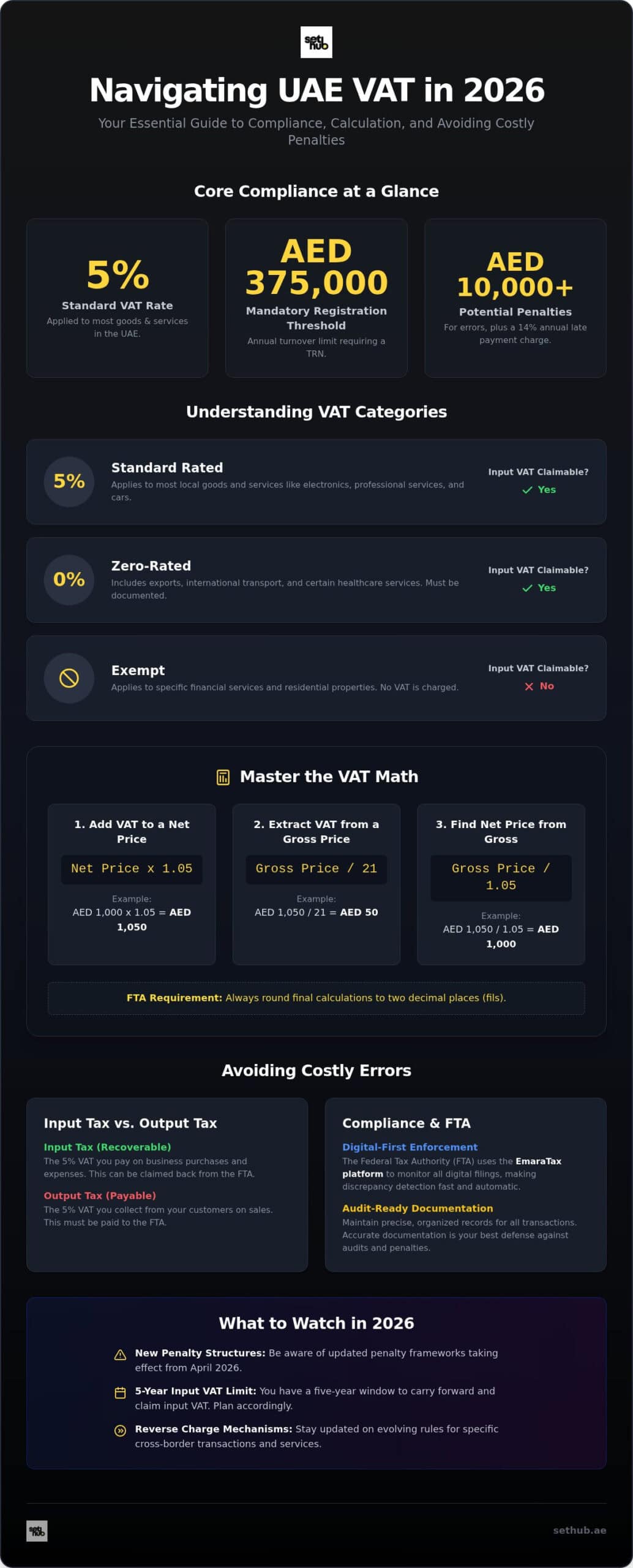
- Adding VAT to a Net Price: To find the total amount to charge a customer, multiply your net price by 1.05. For example, a 1,000 AED service becomes 1,050 AED inclusive of tax.
- Extracting VAT from a Gross Price: If you have a total receipt and need to find the tax portion, divide the gross amount by 21. A 1,050 AED total contains exactly 50 AED in VAT.
- Calculating the Net Price from Gross: To find your actual revenue from an inclusive total, divide the gross amount by 1.05. This helps you understand your true profit margins after the tax is removed.
Rounding to the nearest fils is a specific FTA requirement. In the UAE, you must round to two decimal places. For example, if a calculation results in 10.556 AED, your invoice should reflect 10.56 AED. Small discrepancies in rounding can aggregate over thousands of transactions, potentially leading to audit red flags during a federal review.
VAT Calculation in Excel and Accounting Software
Excel is a powerful ally for small teams looking to maintain organized records. You can build a simple vat calculator template by setting up columns for the Net Amount, VAT Rate (5%), and Total. To ensure your sheet remains compliant with FTA standards, always use the =ROUND(cell, 2) function. This prevents hidden decimal points from skewing your final totals in a tax return.
As your transaction volume grows, manual entry often becomes a bottleneck. Automated accounting software removes this friction by syncing directly with your bank feeds and invoicing. This automation reduces the risk of human error and ensures every fils is accounted for. If you find the initial system setup or tax categorization overwhelming, seeking Corporate Tax & VAT Registration support can ensure your digital systems are configured correctly from day one, allowing you to focus on scaling your operations.
Business Registration Thresholds: When Do You Need a TRN?
Growth is the ultimate goal for any entrepreneur, but with expansion comes new regulatory milestones. In the UAE, crossing a specific revenue threshold isn’t a hurdle; it’s a sign that your business is maturing into a significant market player. Determining when you need a Tax Registration Number (TRN) depends entirely on your taxable supplies and imports. While you might be focused on daily operations, keeping a close eye on your 12-month rolling turnover ensures you don’t miss the window for mandatory registration.
Failing to register on time is a mistake you can’t afford. The Federal Tax Authority (FTA) imposes a fixed penalty of AED 10,000 for late registration. This is why many business owners treat their vat calculator as a diagnostic tool. By tracking your monthly taxable turnover, you can predict exactly when you’ll hit the legal limits. Remember, the calculation isn’t based on a calendar year; it’s based on the previous 12 months or the expectation of exceeding the limit in the next 30 days.
Mandatory vs. Voluntary Registration
The rules are clear and designed to support businesses at different stages of their journey. You must register for VAT if your taxable supplies and imports exceed AED 375,000. This is the point where compliance becomes a legal necessity. However, you don’t have to wait until you’re a large-scale enterprise to join the tax system. Voluntary registration is available once you cross AED 187,500 in taxable supplies or expenses.
Why register early? It’s a strategic move. Voluntary registration allows you to reclaim input VAT on your startup costs, which can significantly improve your initial cash flow. It also builds immediate credibility with larger corporate clients who prefer working with VAT-registered partners. Once you decide to move forward, securing your TRN through a professional Corporate Tax & VAT Registration service removes the administrative friction, letting you stay focused on your vision.
VAT for Free Zone vs. Mainland Entities
Location plays a vital role in how you document your transactions. While most businesses follow standard rules, those operating within “Designated Zones” enjoy specific VAT treatments, particularly for goods stored within these areas. However, providing services from a Free Zone to the Mainland usually triggers standard VAT requirements. This distinction is crucial for maintaining accurate records in your vat calculator and avoiding filing errors. Whether you’re operating in a Mainland hub or a specialized Free Zone, the registration thresholds remain the same, making consistent tracking the only way to ensure total compliance.
Avoiding Costly Errors: Input Tax vs. Output Tax
VAT is a balancing act between what you receive and what you spend. To maintain a healthy cash flow, you must distinguish between Output Tax and Input Tax. Output Tax represents the 5% VAT you collect from your customers on every taxable sale. Conversely, Input Tax is the VAT you pay to your suppliers for business related purchases. Input Tax recovery acts as a vital mechanism to prevent double taxation across the supply chain.
The final figure on your tax return is determined by a simple calculation: Output Tax minus Input Tax. If the result is positive, that amount is payable to the FTA. If it’s negative, you’re eligible for a refund or can carry the credit forward. Using your vat calculator to track these figures monthly ensures you aren’t surprised by a large bill at the end of the quarter. It also helps you spot discrepancies before they become permanent records in your filing.
Maximizing Your VAT Recovery
Reclaiming VAT on eligible expenses is one of the easiest ways to protect your profit margins. Most operational costs, such as office rent, electricity bills, and professional software subscriptions, qualify for recovery. However, the FTA is strict about documentation. A valid tax invoice must include the supplier’s TRN, a unique invoice number, and the date of supply. Without these details, your claim for recovery could be rejected during a federal audit.
Be careful with ‘blocked’ expenses. You cannot reclaim VAT on most entertainment costs, such as client dinners or staff parties. Misidentifying these as recoverable expenses is a common error that can lead to penalties. Keeping your records organized is the only way to ensure every claim is legitimate. If you’re unsure whether an expense is blocked, it’s safer to exclude it or consult an expert rather than risk a compliance flag.
Common Pitfalls in VAT Filing
Errors often occur when businesses handle international transactions. Under the Reverse Charge Mechanism (RCM), you must account for VAT on imported services as if you were both the supplier and the recipient. As of 2026, while you no longer need to issue a self-invoice for these imports, you must still maintain rigorous records of supplier invoices and import documents. Failing to document these properly can lead to the FTA disregarding your input tax claims.
Timing is equally critical. Missing a filing deadline can trigger an immediate AED 1,000 penalty for a first offense. Even worse, late payments now attract a 14% annual charge, calculated monthly. To avoid these costs and ensure your documentation meets the mandatory 5-year retention rule, consider professional Corporate Tax & VAT Registration support. This proactive approach turns a complex administrative burden into a streamlined, managed process.
Streamlining Your Tax Compliance with Set Hub
Manual calculations are a helpful starting point, but they often represent the beginning of a much larger administrative journey. While a vat calculator provides the essential figures, the true value lies in how those numbers are integrated into your broader legal strategy. Since 2009, we’ve assisted over 10,000 entrepreneurs in navigating the complexities of the local market. We specialize in removing the friction from regulatory requirements, transforming tax administration from a source of stress into a routine, managed milestone.
Moving from manual entry to a fully managed tax strategy allows you to reclaim your time. It ensures that every fils is accounted for and every filing is submitted with precision. By partnering with a dedicated team, you shift the burden of compliance from your shoulders to ours. This transition doesn’t just protect you from penalties; it provides a clear, data-driven view of your company’s financial momentum. A critical part of this financial foundation is also ensuring your banking infrastructure is in order, as meeting the corporate bank account requirements in the UAE is essential for seamless tax payments and VAT refund processing. Similarly, employed professionals and business owners alike should ensure they have their ILOE insurance UAE subscription in order, as non-compliance fines can create unexpected administrative complications that affect your overall regulatory standing.
Our Comprehensive Tax and Accounting Services
Set Hub offers a complete suite of solutions designed to handle the heavy lifting of tax administration. We don’t just provide tools; we offer a specialized team that understands the nuances of the UAE’s evolving tax laws. Our services include:
- End-to-end VAT registration: Secure your TRN efficiently without the usual documentation delays.
- Quarterly VAT filing: Ensure your returns are accurate and submitted well before the FTA deadlines.
- Audit preparation: Maintain flawless records that stand up to federal scrutiny at any time.
Strategic tax planning is about more than just avoiding the new 14% annual late payment charges. It’s about optimizing your financial health so you can reinvest in your company’s future growth with total confidence.
Ready to Simplify Your Business Operations?
The 2026 tax landscape requires a holistic approach to financial records. Your VAT documentation is no longer an isolated task; it forms the foundation for your Corporate Tax Registration UAE filings. Discrepancies in your vat calculator results or filing history can ripple through your entire corporate structure, potentially causing issues during a tax audit. As your “Seasoned Navigator,” Set Hub ensures that every element of your tax profile is consistent and compliant.
You deserve the peace of mind that comes from expert-led compliance. You shouldn’t have to monitor changing thresholds or new penalty structures while you’re trying to lead a growing team. Let us audit your current VAT processes and identify opportunities for a more frictionless experience. Book a consultation today to secure your business’s standing and focus on what you do best: building your legacy in the Emirates.
Secure Your Business Momentum in the UAE
Maintaining tax compliance is a vital milestone for any growing business in the Emirates. You’ve learned that while a vat calculator is an essential tool for daily accuracy, long-term success requires a deeper grasp of registration thresholds and input tax recovery. You don’t have to manage these regulatory complexities alone. Since 2009, we’ve helped over 10,000 entrepreneurs navigate the local business landscape with precision and ease. Our dedicated VAT and Corporate Tax specialists are here to ensure your filings are flawless and your documentation is audit-ready.
Are you ready to move past the friction of manual entry? Simplify your UAE tax compliance; consult with Set Hub today and focus on the exciting growth ahead. Your entrepreneurial journey deserves the support of a seasoned navigator who makes complex transitions feel routine. We’re here to help you turn administrative hurdles into simple checkboxes on your path to success. Let’s build your future together.
Frequently Asked Questions
What is the current VAT rate in the UAE for 2026?
The standard VAT rate in the UAE remains 5% for 2026. This rate applies to the majority of goods and services across the country. While some specific sectors qualify for zero-rating or exemptions, most commercial transactions require this standard charge. Maintaining accuracy with a vat calculator ensures you always apply the correct rate to your taxable supplies and stay aligned with FTA requirements.
How do I calculate VAT if the price is already inclusive?
You can extract the tax amount from an inclusive price by dividing the total gross amount by 21. For example, if a total receipt is AED 1,050, dividing by 21 reveals a tax portion of exactly AED 50. This simple formula helps you reconcile your expenses and identify recoverable input tax without needing complex accounting software. It’s a quick way to verify your financial records at a glance.
Is it mandatory for every small business to register for VAT?
Registration is only mandatory if your taxable supplies and imports exceed AED 375,000 over the previous 12 months. Small businesses earning below this specific threshold aren’t legally required to register. However, you can choose to register voluntarily once your turnover or taxable expenses reach AED 187,500. This voluntary path is often a strategic move for startups looking to build immediate market credibility and reclaim their initial costs.
Can I claim back VAT on my business startup costs?
You can reclaim VAT on most professional startup expenses provided your business is VAT-registered with the FTA. This includes costs for office furniture, equipment, and utility setups necessary for your taxable business activities. It’s an effective way to boost your initial cash flow during the critical early stages of company formation. Just ensure you maintain valid tax invoices from your suppliers to support every claim during an audit.
What happens if I submit my VAT return late to the FTA?
Submitting a late return triggers an immediate administrative penalty of AED 1,000 for a first offense. If the error is repeated within 24 months, the fine increases to AED 2,000. Additionally, effective from April 2026, any late tax payments attract a 14% annual charge, which is calculated monthly. These costs can add up quickly, making it vital to use a vat calculator and track your deadlines through the EmaraTax portal.
Do Free Zone companies have to pay VAT?
Free Zone entities are generally subject to the same VAT registration thresholds and rules as Mainland companies. While certain “Designated Zones” enjoy specific treatments for the transfer of goods, most professional services provided from a Free Zone are taxed at the standard 5% rate. It’s a common misconception that Free Zone status equals a total tax exemption. Every entity must monitor its turnover to ensure it meets its legal obligations.
How often does a business need to file a VAT return?
Most businesses in the UAE file their VAT returns on a quarterly basis as assigned by the FTA. Larger enterprises with significantly high annual turnovers might be required to file monthly instead. Your specific tax period and filing deadlines are clearly listed on your dashboard within the EmaraTax portal. Staying organized with these dates ensures you avoid the penalties associated with late submissions and maintains your standing with the authority.
What is a Tax Registration Number (TRN) and how do I get one?
A TRN is a unique 15-digit identification number issued by the FTA to businesses registered for VAT. You can obtain one by submitting a formal application through the EmaraTax platform along with your trade license and financial records. Professional assistance can help you navigate this process, ensuring your documentation is handled correctly. This removes the friction of administrative delays and moves your business toward a state of total compliance. For high-net-worth investors and skilled professionals looking to establish long-term roots in the Emirates, understanding the golden visa UAE requirements and investment thresholds for 2026 is an equally important step alongside securing your tax registration.