


What if the biggest barrier to your global expansion wasn’t the complexity of the law, but the outdated advice you’re still following? Starting a business in the United Arab Emirates in 2026 is no longer just about getting a stamp on a piece of paper. It’s about building a tax-efficient, compliant ecosystem that leverages the nation’s status as a premier global hub. You probably feel the excitement of the UAE’s growth, yet you’re likely concerned about the 9% corporate tax threshold of AED 375,000 or the nuances of 100% foreign ownership on the mainland.
We understand that the regulatory landscape can feel overwhelming when you’re trying to focus on your vision. This guide provides a comprehensive roadmap to launching your company with total ease. We’ll simplify the transition from initial idea to a trade license in your hand. You’ll learn how to navigate Freezone versus Mainland choices, secure residency visas for your team, and handle VAT registration without the stress. By the end, you’ll have a clear, frictionless path to turning your entrepreneurial goals into a functional, compliant reality in the heart of the Middle East.
Key Takeaways
- Master the 2026 regulatory landscape to ensure your business setup in Dubai is a seamless, strategic move for global growth.
- Identify the ideal legal structure for your goals, whether that means direct local market access via Mainland or specialized tax advantages in a Freezone.
- Follow a streamlined six-step roadmap to navigate everything from trade name registration to securing your commercial license without administrative friction.
- Future-proof your operations by mastering the 2026 corporate tax regime and VAT requirements while establishing a legitimate corporate banking presence.
- Unlock long-term residency options, including the 10-year Golden Visa, to anchor your family and top talent in the UAE’s thriving ecosystem.
Why Start a Business in Dubai 2026? Strategic Advantage
Dubai has redefined itself as the ultimate frontier for entrepreneurial ambition. By 2026, the Economy of Dubai has transitioned into a hyper-connected hub where innovation isn’t just encouraged; it’s the standard. For those considering starting a business in dubai, the environment offers more than just a prestigious address. It provides a stable, tax-efficient base with world-class infrastructure that bridges the gap between East and West. You aren’t just entering a local market; you’re gaining a strategic foothold in the MENA region, reaching billions of potential customers within a few hours’ flight. The city acts as a magnet for talent and capital, creating an ecosystem where scaling is a natural progression rather than an uphill battle.
The 2026 Economic Landscape
The UAE’s economic trajectory is currently fueled by high-growth sectors like AI, FinTech, and Green Energy. Digital transformation has reached a point where startup speed is no longer hindered by physical paperwork. With the widespread adoption of digital application portals, the friction of administrative setup has largely vanished. This efficiency is why the UAE consistently ranks as a top destination for Foreign Direct Investment (FDI). E-commerce also continues to surge, supported by a logistics network that remains unrivaled globally. For an entrepreneur, this means your supply chain and digital presence are supported by the best technology available today. If you are looking to source high-quality tech equipment for your new venture, you can learn more about GenX Systems LLC for a wide range of hardware solutions.
Legal Framework and Ownership Rights
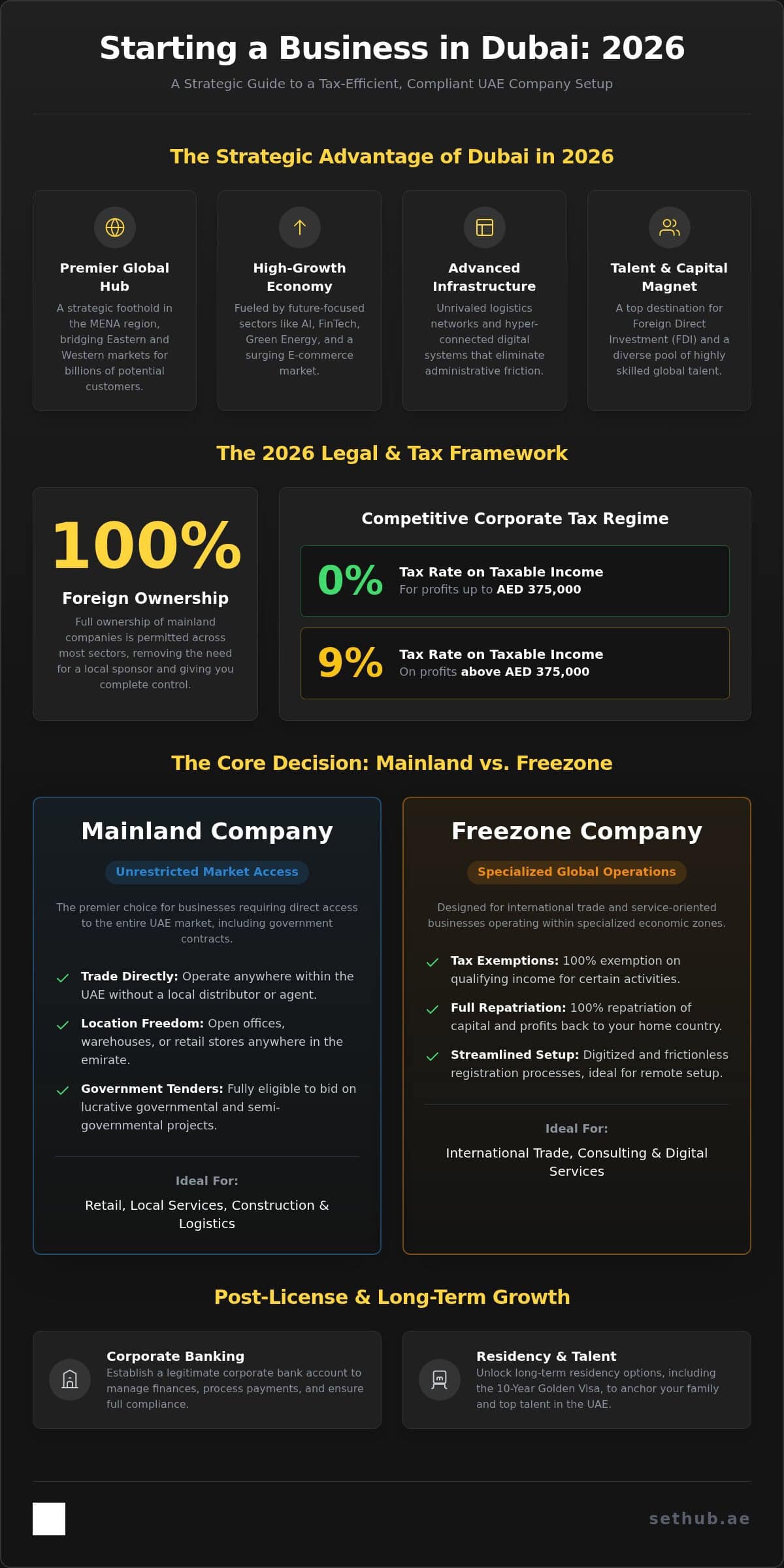
Recent regulatory reforms have fundamentally changed the game for expatriates. The most significant shift is the full implementation of the Commercial Companies Law updates, which allow for 100% foreign ownership of mainland companies across most commercial and industrial sectors. You no longer need a local sponsor to hold a 51% stake in your company. The Department of Economy and Tourism (DET) has streamlined these regulations to ensure that starting a business in dubai is transparent, secure, and fast. This legal clarity gives you full control over your operations and profits from day one, removing the anxiety of third-party interference.
Combine these legal rights with a tax regime that remains highly competitive on the global stage. While a 9% corporate tax applies to taxable income above AED 375,000, the 0% rate for income below that threshold keeps the UAE incredibly attractive for small businesses and startups. It’s a balanced system designed to foster long-term growth while maintaining international compliance standards. This environment ensures that your hard-earned revenue stays where it belongs: in your business, ready to fund your next phase of expansion.
Choosing the Right Structure: Mainland vs. Freezone
Selecting the correct jurisdiction is the most pivotal step in your journey. While the excitement of starting a business in dubai is high, your choice between Mainland and Freezone will dictate your future operational reach and market access. It isn’t just about where your office is located; it’s about who you can sell to and how you plan to scale. Each structure offers a unique set of benefits tailored to different business models, from local retail and construction to global digital services and consultancy.
Mainland Company Formation
A Mainland setup is the premier choice for those requiring unrestricted access to the entire UAE market. Managed by the Department of Economy and Tourism (DET), this structure allows you to trade directly with consumers and bid for lucrative government tenders without the need for a distributor. There are no geographic limits on where you can open your office, storefront, or warehouse within the emirate. This flexibility is essential for businesses that rely on local foot traffic, such as the creative workshops hosted by Art Therapy. For a deeper understanding of this versatile structure, see our Expert Business Setup in Dubai: The 2026 Strategic Guide to UAE Formation.
Freezone Company Registration
Freezones provide a specialized environment designed for international trade and tech-driven enterprises. Hubs like the International Free Zone Authority (IFZA) or Meydan Free Zone offer industry-specific clusters that foster innovation and collaboration. These jurisdictions are particularly attractive for remote entrepreneurs because they allow for 100% tax exemptions on qualifying income and full capital repatriation. The registration process is frequently digitized, making it a frictionless entry point for those managing their setup from abroad. Learn more about these specialized hubs in our Complete Guide to Free Zone Company Registration in the UAE (2026).
Beyond market access, your decision should account for physical office requirements and visa needs. Mainland licenses usually necessitate a physical office lease, with your visa quota often determined by the square footage of the premises. In contrast, Freezones offer cost-effective virtual office or flexi-desk solutions, which can range from AED 5,000 to AED 15,000 annually. This makes them an ideal starting point for lean startups or digital nomads. However, if your long-term goal involves physical retail or local distribution, the Mainland’s flexibility is unmatched. To understand how your workspace choice directly impacts your visa eligibility and compliance obligations, explore our guide to office space solutions Dubai businesses rely on in 2026. Choosing the right path ensures that starting a business in dubai remains a smooth, profitable transition from day one.
When establishing your physical presence, modernizing your workspace with smart technology is key; Rocatech provides the automation and smart lighting solutions necessary to build a highly efficient and future-ready office in Dubai.
Ready to see the numbers for yourself? Use our business setup cost calculator to compare structures and find the most efficient path for your budget and growth strategy.
The 6-Step Roadmap to Starting Your Business
Transforming your entrepreneurial vision into a legal entity requires a structured approach. While the administrative landscape might seem dense, breaking it down into logical milestones ensures a frictionless experience. By following this six-step roadmap, you can transition from an idea to an operational company with speed and precision. Every milestone you cross brings you closer to your goal of starting a business in dubai.
- Step 1: Select your business activity and legal form. This choice dictates whether you need a commercial, industrial, or professional license.
- Step 2: Register your trade name and obtain initial approval. This confirms the government has no objection to you starting your venture.
- Step 3: Draft and notarize the Memorandum of Association (MOA). This document outlines the ownership structure and operational rules.
- Step 4: Secure a physical or virtual office space. Mainland businesses require a physical lease, while Freezones often offer flexible virtual options.
- Step 5: Apply for your trade license and pay the associated fees. Once approved, you’ll receive your commercial register.
- Step 6: Complete the residency visa process and open your corporate bank account to begin operations.
Activity Selection and Trade Name Registration
Accuracy at the start prevents delays later. Your chosen activity must align perfectly with the official Department of Economy and Tourism (DET) or specific Freezone lists. If your activity isn’t listed, you might face complications during the approval stage. When starting a business in dubai, your trade name must also follow strict protocols. Avoid restricted words, religious references, or names of existing global brands. If you are also researching the American market, you can explore LLC and Business Formation Services to check name availability and entity requirements across the United States. The Initial Approval certificate is your first major win. It acts as a green light to proceed with the legal drafting of your company documents.
For those specializing in the media sector, ensuring you have the right technical infrastructure is a parallel priority; United Broadcast & Media Solutions (UBMS) offers the professional video and cinema cameras necessary to meet the high production standards of the Dubai market.
Licensing and Documentation
The documentation phase is where many entrepreneurs feel the most friction. You’ll need to gather passport copies, detailed business plans, and potentially No Objection Certificates (NOCs). This is where professional support becomes invaluable. Set Hub’s PRO services accelerate this phase by handling the direct interactions with government departments on your behalf. We ensure your MOA is notarized correctly and all external approvals are secured without you having to visit multiple offices. Once the fees are settled, your trade license is issued, marking the official birth of your business. With your license in hand, you’re ready to finalize your residency and establish your banking presence.
Post-License Compliance: Banking, Tax, and VAT
Receiving your trade license is a major milestone, but it’s the beginning of your operational journey. In 2026, staying compliant with the UAE’s evolving financial regulations is non-negotiable. It ensures your business remains in good standing while protecting your hard-earned revenue. When you’re starting a business in dubai, you must shift your focus immediately to three pillars: tax registration, VAT compliance, and banking. These aren’t just hurdles; they’re the foundation of your company’s legitimacy and long-term success.
Corporate Tax and Small Business Relief
The UAE’s corporate tax landscape is designed to support growth while aligning with global standards. As of 2026, a standard corporate tax rate of 9% applies to taxable income exceeding AED 375,000. For many startups, this means you’ll benefit from a 0% rate on your initial profits. You can also leverage Small Business Relief (SBR) to further simplify your obligations if your revenue falls below specific thresholds. It’s vital to register with the Federal Tax Authority (FTA) soon after your license is issued to avoid administrative penalties. For a precise look at your potential obligations, use our VAT Calculator UAE: A Comprehensive Guide to 2026 Tax Compliance.
Beyond corporate tax, you need to monitor your revenue for VAT purposes. The mandatory registration threshold remains at AED 375,000 in annual revenue, while the voluntary registration threshold is AED 187,500. Maintaining meticulous financial records isn’t just a suggestion; it’s a requirement for annual audits and maintaining a healthy business. Precise record-keeping makes the audit process a simple checkbox rather than a source of anxiety.
Opening a Corporate Bank Account
You can’t trade effectively without a dedicated corporate bank account. While the UAE banking sector is robust, the Know Your Customer (KYC) procedures have become increasingly stringent to ensure financial transparency. Banks require your full trade license, Memorandum of Association (MOA), and proof of a physical address, such as utility bills or a lease agreement. This process can sometimes take weeks if handled alone, but digital-first solutions like Wio have revolutionized the experience for entrepreneurs. These platforms offer faster onboarding and a more intuitive interface for managing daily transactions.
Opening an account is the final step in establishing your operational legitimacy. It allows you to pay employees, settle invoices, and demonstrate financial transparency to your partners. If you’re feeling overwhelmed by the paperwork, you can partner with Set Hub for Corporate Tax & VAT Registration to ensure every compliance box is checked correctly from day one.
Residency and Long-Term Growth Strategies
Starting a business in dubai is the first step toward a broader life and career strategy in the Middle East. Once your license is secured, your next priority is anchoring your presence through residency. The UAE offers various pathways to ensure you and your team can focus on growth without the friction of frequent renewals. Most entrepreneurs begin with a standard Investor Visa, which typically provides residency for two to three years. However, if your vision involves long-term stability, the Golden Visa has become the premier choice for innovators and high-impact founders.
Beyond your own status, your business license acts as a platform for your entire support network. You can sponsor your spouse, children, and parents, providing them with the same residency benefits you enjoy. You also have the authority to sponsor your employees, which is essential for attracting international talent to your team. This ability to consolidate your personal and professional life under one corporate umbrella is a significant advantage of the UAE ecosystem. It turns your business from a mere trade entity into a foundation for a new life. Selecting the right office space solutions in Dubai is equally critical at this stage, as your workspace directly determines the number of residency visas your license can support.
Beyond the administrative setup, establishing a new life in the UAE involves finding your community and local resources. To help navigate the cultural and social aspects of your move, learn more about EBMS Business Services LLC and their detailed guides for new residents.
Securing Your Future: The Golden Visa
In 2026, the Golden Visa remains the most sought-after residency status for high-achieving entrepreneurs. To qualify, your startup must demonstrate annual revenues of at least AED 1,000,000. Alternatively, if you’ve founded a project approved by a UAE-accredited business incubator, you may also be eligible for this 10-year renewable residency. The primary benefit is total independence; you don’t need a local sponsor, and you can stay outside the UAE for extended periods without losing your visa. It provides a level of peace of mind that allows you to manage global operations with ease. For a detailed breakdown of the application process, consult The Ultimate Guide to the UAE Golden Visa in 2026: Requirements, Benefits, and Application.
Expanding into Saudi Arabia
While starting a business in dubai provides a world-class foundation, the logical next step for many firms is the Saudi Arabian (KSA) market. The synergy between the two nations allows for a seamless expansion strategy. KSA’s Vision 2030 has opened massive opportunities in technology, tourism, and infrastructure. We facilitate this transition by handling cross-border licensing and setup, ensuring your UAE-based operations complement your Saudi expansion. This dual-market approach positions your brand as a regional leader, tapping into the largest economies in the Arab world simultaneously.
Scaling doesn’t have to be a solo journey. Set Hub acts as your strategic partner, offering ongoing HR support and office space solutions to ensure your team and brand grow at the same pace as your ambitions. Whether you’re hiring your first local employee or launching a branch in Riyadh, we ensure the transition is routine and reliable. As you scale your workforce, you can learn more about ZLK Garments for professional uniform and workwear solutions that align with your corporate identity. Your business setup is just the beginning of a long-term partnership for growth.
Your Future in Dubai Starts Today
Your vision for 2026 deserves a foundation built on clarity and speed. You’ve seen how the right choice between Mainland and Freezone jurisdictions can define your market reach. You also understand that navigating the 9% corporate tax threshold is a manageable milestone with the right financial structure in place. Starting a business in dubai isn’t just about obtaining a trade license; it’s about securing a long-term future through residency and cross-border expansion into markets like Saudi Arabia.
At Set Hub, we’ve refined this process into a frictionless science. Since 2009, we’ve empowered over 10,000 entrepreneurs to launch and scale their ventures with complete confidence. From handling complex PRO documentation to streamlining your corporate banking setup, we ensure every administrative hurdle becomes a simple checkbox on your path to success. Our expertise across both UAE and KSA markets means your growth never has to stop at the border.
Ready to launch? Get a frictionless business setup consultation with Set Hub today.
The UAE’s economic momentum is waiting for your contribution. It’s time to turn your entrepreneurial goals into a thriving reality.
Frequently Asked Questions
Can a foreigner own 100% of a business in Dubai?
Yes, foreigners can enjoy 100% ownership of their companies in the UAE. This applies to most commercial and industrial activities on the Mainland as well as all Freezone structures. The removal of the local sponsor requirement has made starting a business in dubai more attractive than ever. You maintain full control over your operations and profits from day one without needing a local partner.
What is the minimum cost to start a small business in Dubai in 2026?
Setup costs depend on your jurisdiction and activity. Freezone licenses can start as low as د.إ 12,500 for zero-visa packages in certain zones. Mainland professional licenses typically range from د.إ 10,000 to د.إ 18,000, while general trading licenses may cost between د.إ 15,000 and د.إ 25,000. These figures exclude office rent and visa processing fees, which are additional operational expenses to consider.
How long does it take to get a trade license in the UAE?
You can often receive your license in as little as two to five working days. Freezones are particularly efficient, with many offering digital portals for instant approvals. Mainland licenses through the Department of Economy and Tourism (DET) are also fast, typically taking less than a week once your trade name is approved and the legal documents are notarized by the authorities.
Do I need a physical office to start a business in Dubai?
It depends on your license type. Mainland companies must have a physical office lease to comply with DET regulations. However, many Freezones provide flexi-desk or virtual office solutions, which are perfect for remote entrepreneurs. These options satisfy the legal requirement for a registered address without the high overhead of a traditional commercial space, costing between د.إ 5,000 and د.إ 15,000 annually.
What are the main differences between Freezone and Mainland companies?
The primary difference is market access. Mainland companies can trade anywhere in the UAE and bid for government contracts without restrictions. Freezone companies are generally limited to trading within their specific zone or internationally. However, Freezones offer highly specialized industry clusters and streamlined ownership benefits that are ideal for exporters, consultants, and digital service providers looking for a cost-effective entry point.
Is corporate tax mandatory for all startups in the UAE?
Every business must register for corporate tax, but not all will pay it. A 0% tax rate applies to all taxable income up to د.إ 375,000, providing significant relief for startups. If your profits exceed this threshold, a 9% rate applies. Additionally, qualifying persons in Freezones may still benefit from a 0% rate on qualifying income, making it a highly tax-efficient environment for growth.
Can I apply for a Golden Visa through my new business?
Yes, entrepreneurs are eligible for a 10-year Golden Visa under specific conditions. Your startup must demonstrate an annual revenue of at least د.إ 1,000,000 to qualify. Alternatively, if you’re a founder of a project approved by an accredited business incubator, you can secure long-term residency. This path provides a stable, sponsor-free future for you and your family while starting a business in dubai.
What documents are required to open a corporate bank account?
Banks require a comprehensive set of documents for their KYC procedures. You’ll need your valid trade license, notarized Memorandum of Association (MOA), and shareholder passport copies. Most banks also ask for proof of a physical address, such as a utility bill or a registered lease agreement. Having these documents organized ensures a smoother application process and helps you establish operational legitimacy quickly.
Need help with this? Set Hub’s consultants can help with estimate your business setup cost. Book a consultation to get started.