


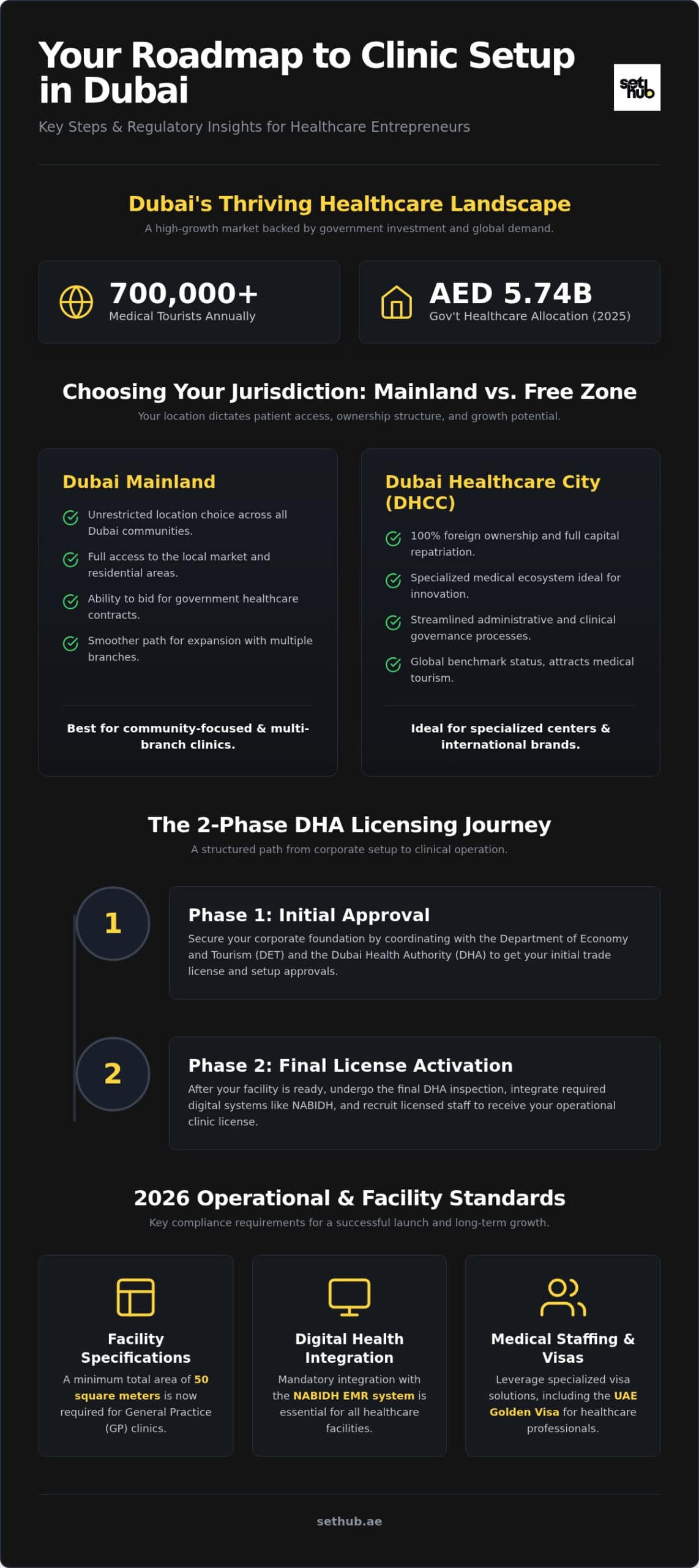
With Dubai attracting over 700,000 medical tourists annually, the opportunity to launch a healthcare practice has never been more lucrative, yet the regulatory barrier remains high. You likely recognize that a successful clinic setup in dubai requires more than just clinical excellence; it demands a precise alignment with the latest 2026 DHA standards and Department of Economy and Tourism mandates.
It’s natural to feel overwhelmed by shifting requirements like the new 50 square meter minimum for GP clinics or the mandatory integration of the NABIDH EMR system. You want to focus on patient care, not get lost in a maze of licensing fees and jurisdiction choices. This expert-led roadmap provides the clarity you need to move forward with confidence. We’ll break down the specific costs, timelines, and legal structures to ensure your facility is fully compliant and ready for long-term growth.
Key Takeaways
- Identify the strategic advantages of Mainland versus Free Zone jurisdictions to optimize your clinic’s patient accessibility and market growth.
- Master the two-phase DHA licensing journey to ensure a frictionless clinic setup in dubai while avoiding common regulatory pitfalls.
- Align your facility with the latest 2026 engineering standards and mandatory digital health integrations for a successful operational launch.
- Streamline medical staff recruitment and residency by leveraging specialized visa solutions, including the UAE Golden Visa for healthcare professionals.
- Establish a robust corporate foundation by navigating the complexities of healthcare-specific banking and the latest UAE corporate tax requirements.
Navigating the Healthcare Landscape for Clinic Setup in the UAE
The UAE’s healthcare sector is no longer just a local service; it’s a global destination. With medical tourism numbers reaching 700,000 in Dubai, the demand for high-quality private care is surging. The federal government’s allocation of AED 5.745 billion toward healthcare in 2025 underscores a deep commitment to infrastructure growth. If you’re planning a clinic setup in dubai, you’re entering a market that values innovation and specialized care. Success depends on understanding the nuances between various regulatory bodies and facility types. Professional consultancy isn’t just a convenience. It’s a strategic necessity to ensure your business structure aligns with clinical requirements from the start.
Understanding Regulatory Jurisdictions
Choosing where to plant your roots is your first major decision. The Dubai Health Authority (DHA) oversees the private healthcare sector in Dubai’s mainland, focusing on facility standards and professional licensing. In contrast, the Ministry of Health and Prevention (MOHAP) sets the overarching national standards across the Emirates. If you choose a free zone, such as Dubai Healthcare City (DHCC), you’ll work with the Dubai Healthcare City Authority (DHCA). These entities don’t work in isolation. They coordinate closely with the Department of Economy and Tourism (DET), which issues your commercial trade license. Managing these parallel tracks requires a seasoned navigator who understands how a DET license impacts your DHA clinical approval.
Identifying Your Clinic Category
Your clinic’s scope of service dictates your physical space requirements and staffing needs. A standard Medical Clinic usually focuses on primary care, while a Polyclinic offers multiple specialties under one roof. Specialized Medical Centers are reserved for more complex, focused disciplines. Picking the right activity code during your trade license application is vital for a smooth clinic setup in dubai; a mismatch here can lead to costly delays during the DHA inspection phase. According to 2026 regulatory standards, a Medical Clinic is defined as a healthcare facility providing outpatient services with a minimum total area of 50 square meters for general practice. This specific classification ensures that every facility meets the high standards patients expect in Dubai’s modern healthcare ecosystem.
Selecting Your Jurisdiction: Mainland vs. Dubai Healthcare City (DHCC)
Location is the heartbeat of your medical practice. It dictates your patient reach, operational freedom, and long term scalability. For most healthcare entrepreneurs, the choice between a Mainland setup and a Free Zone is the most critical hurdle in a clinic setup in dubai. While Mainland offers deep integration into local residential communities, Free Zones like DHCC provide a prestigious, specialized environment tailored for international excellence. Your decision should align with your specific medical specialty and target patient demographic.
Mainland Clinic Formation Advantages
Mainland setups are regulated by the Department of Economy and Tourism (DET) in coordination with the DHA. This path offers unparalleled flexibility. You can open your doors in any high growth neighborhood, from Jumeirah to Mirdif, without geographical restrictions on where your patients come from. Mainland clinics also have the unique advantage of bidding for government healthcare contracts and treating patients with various local insurance plans more easily. If you want to expand to multiple branches across the Emirates, the Mainland structure provides the smoothest path for growth. While you can explore our Complete Guide to Free Zone Company Registration in the UAE (2026) for a broader view of the landscape, Mainland remains the gold standard for community focused primary care.
Free Zone Opportunities for Specialized Healthcare
Dubai Healthcare City (DHCC) is a global benchmark for medical innovation. It’s an ecosystem designed for collaboration between international medical brands and specialized practitioners. The primary draw is 100% foreign ownership, allowing you to maintain full control of your clinical enterprise. The Dubai Healthcare City regulations are crafted specifically for the medical sector, which often results in a more streamlined administrative experience for clinical governance. DHCC is ideal for specialized centers that rely on medical tourism or high tech surgical facilities.
Cost implications vary significantly between these jurisdictions. DHCC involves an initial application fee of AED 1,000, with professional license upgrades for doctors costing AED 4,000. Mainland setups may involve different trade license costs based on your specific location and facility size, though DHA renewal fees for general practitioners are fixed at AED 3,000. Balancing these initial investments against your projected patient volume is essential. If you’re feeling stuck between these two paths, consulting a seasoned navigator can help you weigh the long term ROI of each jurisdiction before you commit your capital.
The Step-by-Step DHA Licensing Journey and Documentation
Transforming a business vision into a clinical reality requires a structured, two-phase approach. In 2026, the process for a clinic setup in dubai remains a dual track journey involving both commercial registration and clinical governance. While the paperwork might seem dense, viewing these milestones as simple checkboxes ensures you maintain momentum without getting bogged down in regulatory friction. The entire process, from your initial application to receiving your final facility license, typically spans two to four months depending on the complexity of your medical services.
Phase 1: Trade Name and Initial Consent
Your first move is securing a trade name through the Department of Economy and Tourism (DET). This name must comply with UAE naming conventions and reflect your medical activity. Once the name is reserved, you’ll submit a detailed proposal letter and an undertaking letter to the Dubai Health Authority (DHA). This step is vital because it culminates in the ‘Initial Approval’ certificate. Think of this certificate as your green light; it’s the specific document that allows you to sign a lease and begin the technical fit-outs of your facility. At this stage, you’ll also need to submit preliminary engineering floor plans that meet the updated 2026 DHA Health Facility Guidelines. For a broader understanding of how commercial registration works alongside clinical approvals, our guide on expert business setup in Dubai for 2026 provides essential context on trade license structures and corporate formation strategies.
Phase 2: Facility Inspection and Final License
Once your facility’s physical construction is complete, the focus shifts to operational readiness. You’ll manage your medical staff’s licensing through the DHA Sheryan portal, ensuring your Medical Director and clinicians have completed their Primary Source Verification (PSV) via DataFlow. For doctors, this verification fee is AED 1,235. The final hurdle is the DHA site inspection, where authorities verify that your physical space matches your approved blueprints and meets all safety standards. To ensure a successful clinic setup in dubai, your facility must be fully equipped and staffed before requesting this visit.
5 Critical Actions for the Final Facility Inspection:
- Verify Room Dimensions: Ensure your GP consultation rooms meet the minimum 9 square meter requirement and the total facility area is at least 50 square meters.
- Connect to NABIDH: Provide documented proof that your Electronic Medical Record (EMR) system is fully integrated with the National Backbone for Integrated Dubai Health.
- Sterilization Protocols: Confirm that designated sterilization areas are correctly partitioned and equipped according to DHA engineering standards.
- Staff Credentialing: Have all original documents and DHA eligibility letters for your Medical Director and nursing staff ready for onsite verification.
- Equipment Calibration: Ensure every piece of medical equipment is calibrated, with maintenance contracts and safety certificates clearly filed.
After a successful inspection and payment of the license activation fees, which range from AED 3,000 to AED 10,000 depending on your specialty, your facility license will be issued. This marks the transition from an applicant to a fully operational healthcare provider in Dubai’s thriving market.
Operational Standards: Facility Design and Medical Staffing
A successful clinic setup in dubai isn’t just about obtaining a piece of paper; it’s about building a space that meets the highest clinical benchmarks. Your physical facility and your medical team are the two pillars that support your DHA license. In 2026, the Dubai Health Authority has refined its engineering standards to ensure patient safety and operational efficiency are never compromised. Compliance starts long before you hire your first nurse; it begins with the blueprints.
Healthcare Interior Design and Fit-Out
Your clinic’s layout must be designed by a DHA-approved engineering company. These experts ensure your floor plans account for the latest 2026 space requirements. For instance, a general practice clinic now requires a minimum total area of 50 square meters, while specialist centers must provide at least 70 square meters. Every consultation room must be at least 9 square meters to allow for proper patient movement and equipment placement.
- Sterilization and Hygiene: Designate specific zones for sterilization that are physically partitioned from clinical areas to prevent cross-contamination.
- Waste Management: Your facility must have a dedicated, secure room for medical waste storage, compliant with Dubai Municipality standards.
- Accessibility: Facilities must adhere to the Dubai Universal Design Code, ensuring seamless access for people of determination.
- Radiation Protection: If your clinic includes X-ray or imaging services, lead-lined walls and specialized shielding are mandatory and must be certified by the DHA.
Staffing Solutions and Professional Licensing
Recruiting the right talent is only half the battle. Every healthcare professional, from specialists to allied health staff, must have their credentials verified through the DataFlow process. Doctors and dentists face a verification fee of AED 1,235, while nurses and allied professionals pay AED 935. Once verified, these professionals must be linked to your facility via the Sheryan portal. A critical requirement is the appointment of a Medical Director, who is legally responsible for the clinic’s clinical governance and regulatory compliance.
Managing the overlap between professional licensing and labor contracts can be complex. You must submit a staffing plan for approval before issuing employment visas. To simplify this process, many entrepreneurs use a seasoned navigator to manage PRO services and staff recruitment in parallel. This approach ensures that your team is licensed and ready to practice the moment your facility opens. Don’t forget that medical malpractice insurance is a non-negotiable requirement for all clinical staff before they can treat their first patient.
Scaling Your Healthcare Business: Visas, Tax, and Corporate Support
Completing your clinical licensing is a major milestone, but the long term vitality of your practice depends on a robust corporate foundation. Scaling a clinic setup in dubai requires a strategic approach to residency, financial compliance, and ongoing administrative management. In 2026, the UAE has introduced streamlined paths for healthcare professionals to secure their future, making it easier than ever to attract and retain world class medical talent. Transitioning from a new startup to an established healthcare provider is a process of checking off final administrative boxes to ensure frictionless growth.
Residency for Medical Professionals
Attracting top tier specialists is easier when you can offer long term residency security. Many doctors and specialized researchers now qualify for the UAE Golden Visa, a 10 year residency that grants them independence from employer sponsorship. This is a powerful recruitment tool that stabilizes your workforce. For investors and general staff, you might choose between a standard residency or a long term visa depending on your capital commitment. You can explore the specific differences in our Investor Visa vs Golden Visa UAE: A Comparative Guide for 2026. Beyond the primary license holder, your clinic acts as the sponsor for staff and their families, requiring a dedicated PRO service to manage renewals and visa cancellations without disrupting your daily operations.
Financial and Tax Compliance
The financial landscape for healthcare providers has evolved with the mandatory implementation of Corporate Tax. All medical entities must register with the Federal Tax Authority (FTA). While taxable income up to AED 375,000 is subject to a 0% rate, any profit exceeding this threshold attracts a 9% tax. Maintaining precise records is essential for compliance and for the eventual scaling of your business. VAT also plays a unique role in healthcare; many preventive and basic medical services are zero-rated, meaning you don’t charge VAT to patients but can still reclaim VAT on your business expenses.
Securing a corporate bank account is often cited as a significant challenge for new clinics due to the high volume of third party insurance transactions. Banks in 2026 require thorough documentation, including your DHA license, lease agreement, and a clear business plan. Choosing a banking partner with a specialized healthcare desk can significantly speed up your approval process. Once your accounts and tax registrations are active, your clinic setup in dubai is truly complete. You’re no longer just an applicant; you’re a strategic partner in the UAE’s thriving healthcare ecosystem, ready to focus entirely on patient outcomes and entrepreneurial growth.
Launch Your Healthcare Vision in Dubai
Launching a medical facility in a world-class hub like Dubai is an ambitious and rewarding venture. By now, you understand that success hinges on making the right jurisdiction choice and strictly adhering to the latest 2026 DHA standards. Whether you’re designing a specialist center in DHCC or a community clinic on the Mainland, every regulatory step is a building block for your future reputation. A successful clinic setup in dubai isn’t just about meeting requirements; it’s about creating a sustainable foundation for patient care.
You don’t have to manage this complex transition alone. From securing initial DHA and MOHAP regulatory approvals to navigating the nuances of corporate tax and VAT registration, the right partner turns administrative hurdles into simple milestones. We also provide comprehensive Golden Visa support for medical specialists, ensuring your top talent has the long-term residency they deserve. Start your clinic setup journey with a free consultation from Set Hub experts today. Your path to a compliant, thriving medical practice is ready for its first step.
Frequently Asked Questions
How much does it cost to set up a medical clinic in Dubai in 2026?
Setting up a medical clinic in Dubai typically requires an investment ranging from AED 400,000 to AED 1,200,000 in the first year. This estimate covers licensing fees, facility rent, medical equipment, and initial staffing costs. Specific DHA licensing fees range from AED 3,000 to AED 10,000 depending on your medical specialty. Your total capital requirement will fluctuate based on the clinic’s size and the complexity of the medical services provided.
Can a foreigner own 100% of a medical clinic in the UAE Mainland?
Yes, foreigners can enjoy 100% ownership of a medical clinic on the UAE Mainland. Recent regulatory shifts allow international entrepreneurs to maintain full control of their healthcare enterprise without the need for a local partner. This makes a clinic setup in dubai highly attractive for global medical brands looking to establish a direct presence in the region’s thriving healthcare market.
What is the minimum space requirement for a polyclinic according to DHA?
A specialist clinic or polyclinic requires a minimum total area of 70 square meters according to the updated March 2026 DHA standards. This is an increase from previous requirements to ensure better patient flow and safety. Additionally, each consultation room must be at least 9 square meters. Your facility design must strictly adhere to these engineering guidelines to pass the mandatory DHA site inspection.
How long does the entire clinic licensing process take from start to finish?
The entire licensing journey usually takes between two to four months to complete. This timeline includes securing initial approvals from the Department of Economy and Tourism, completing the facility fit-out, and passing the final DHA inspection. The speed of the process for a clinic setup in dubai often depends on how quickly you can finalize your facility’s physical space and complete the staff verification through DataFlow.
What are the requirements for a Medical Director in a new clinic?
Every new clinic must appoint a Medical Director who is a DHA-licensed physician with the appropriate seniority. This individual takes legal and clinical responsibility for the facility’s operations and regulatory compliance. They must oversee clinical governance and ensure all medical staff adhere to DHA Health Facility Guidelines. You’ll need to submit their credentials and a formal undertaking letter during the licensing phase.
Is medical malpractice insurance mandatory for all clinic staff?
Yes, medical malpractice insurance is a non-negotiable requirement for all clinical staff practicing in the UAE. You must secure this coverage for every doctor, nurse, and allied health professional before they’re permitted to treat patients. This insurance protects both the practitioner and the facility, serving as a critical component of your operational readiness and final license activation.
Can I convert a residential villa into a medical clinic?
You can convert a residential villa into a medical clinic if the property is located in an area zoned for commercial or medical use. The building must also be modified to meet strict DHA engineering standards, including accessibility and sterilization requirements. You’ll need specific approvals from both the Dubai Municipality and the DHA before beginning any structural changes or fit-outs.
Do I need a separate license to include a pharmacy within my clinic?
You do need a separate pharmacy license if you intend to dispense medications within your facility. While your clinic license covers medical services, a pharmacy is viewed as a distinct activity regulated by both the DHA and the Ministry of Health and Prevention. This requires its own set of approvals, specialized staffing, and a dedicated physical space that meets pharmaceutical storage standards.
Need help with this? Set Hub’s consultants can help with estimate your business setup cost. Book a consultation to get started.