


In 2026, a UAE trade license is only half the battle. The real challenge is proving your business’s legitimacy to a compliance officer who has seen it all. You’ve likely heard the horror stories of 12-week onboarding delays or sudden rejections without any clear explanation. It’s frustrating when your entrepreneurial momentum is stalled by a mountain of paperwork. We understand that meeting the corporate bank account requirements uae can feel overwhelming, especially with stricter KYC and physical office mandates now in full effect.
This guide changes that. You’ll master the essential documentation and procedural steps to secure your UAE business bank account with efficiency and confidence. We’ll provide a clear checklist of requirements, break down the current costs, and help you select the right bank for your specific activity. From understanding minimum balance thresholds to choosing between digital-first platforms and traditional institutions, you’re about to turn a complex hurdle into a simple checkbox on your path to success.
Key Takeaways
- Navigate the 2026 landscape where a dedicated account is a legal necessity for salary payments through WPS and corporate tax compliance.
- Master the essential corporate bank account requirements uae with our comprehensive checklist of mandatory legal and personal documentation.
- Evaluate the trade-offs between established traditional banks and modern digital platforms to find the perfect fit for your business’s operational needs.
- Learn the secret to creating a bank-ready executive summary that streamlines the KYC process and significantly reduces the risk of rejection.
- Discover how expert pre-screening can transform a complex, months-long onboarding journey into a frictionless administrative milestone.
Understanding the UAE Corporate Banking Landscape in 2026
Operating a business in the UAE without a dedicated corporate account is no longer just a hurdle; it is a legal impossibility. The Central Bank of the UAE has implemented rigorous oversight to align with global financial standards. This evolution ensures the UAE remains a premier destination for international capital, but it also means the corporate bank account requirements uae have become more specific. Whether you are a solo entrepreneur or a growing SME, your banking choice now dictates your operational speed.
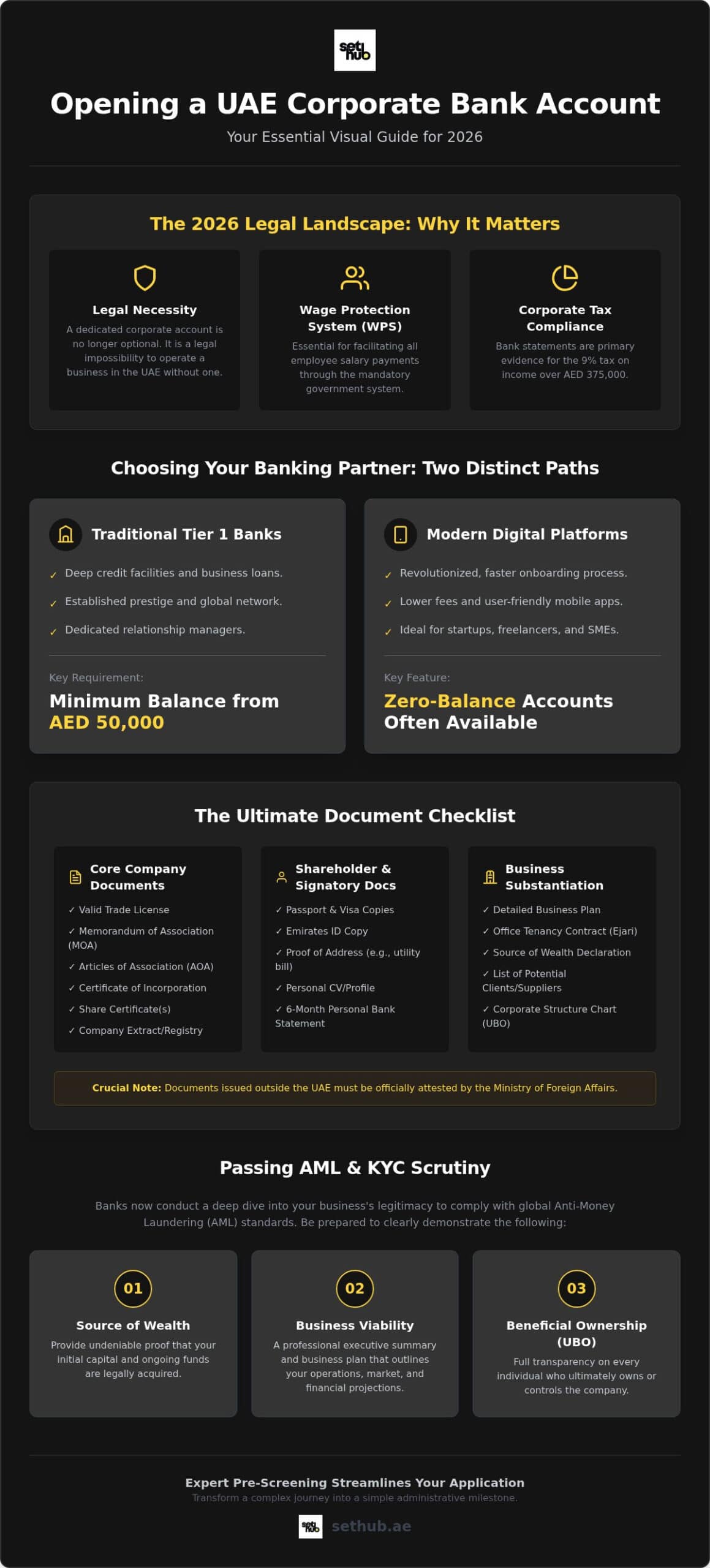
The 2026 landscape is defined by two distinct paths. Traditional Tier 1 banks offer deep credit facilities and prestige but require significant minimum balances, often starting at AED 50,000. Conversely, digital-first platforms like Wio Bank and Mashreq NeoBiz have revolutionized onboarding for startups. These digital options often provide zero-balance accounts and faster approvals, catering to the momentum of new businesses. Your jurisdiction also plays a role; mainland companies typically experience a smoother path than free zone entities due to their direct local presence and physical office requirements.
The Necessity of Corporate Financial Separation
Commingling personal and business funds is a fast track to regulatory scrutiny. A dedicated account is the only way to maintain the “corporate veil” that protects your personal assets. Beyond protection, a corporate account is essential for corporate tax registration uae. With the 9% tax rate now applied to taxable income exceeding AED 375,000, your bank statements serve as the primary evidence for compliance. Clear financial separation allows you to:
- Facilitate employee salary payments through the mandatory Wage Protection System (WPS).
- Build a verifiable credit history to access future business loans or expansion capital.
- Simplify annual audits and VAT filings with organized, business-only transaction data.
Current Regulatory Environment and AML Compliance
The UAE’s commitment to financial transparency has solidified its “White List” status globally. This reputation is maintained through strict Anti-Money Laundering (AML) and Counter-Terrorism Financing (CTF) protocols. In 2026, banks aren’t just looking at your license; they’re looking at your history. Expect a deep dive into your “Source of Wealth” to prove that your initial capital was legally acquired. While this scrutiny might feel intense, it protects the integrity of the local market. Providing comprehensive documentation upfront is the best way to move through these checks without friction. Banks prioritize applicants who show a clear understanding of their own financial flows and ultimate beneficial ownership (UBO). As an employer, staying current with all mandatory employee protections — including ILOE insurance UAE subscriptions for your staff — also signals to compliance officers that your business operates with full regulatory awareness.
Essential Corporate Bank Account Requirements in the UAE
Success in UAE banking begins with a flawless document file. While the list might seem long, it’s a predictable set of standards designed to ensure your business is ready for global trade. Meeting the corporate bank account requirements uae is largely about precision. One missing signature or an outdated document can reset your onboarding timeline by weeks. We’ve simplified this into a manageable checklist so you can approach the process with confidence.
The 2026 regulatory environment demands transparency. Banks aren’t just looking for your license; they’re looking for a clear picture of your business’s structure and its owners. If the thought of compiling this list feels daunting, you don’t have to do it alone. Many entrepreneurs find that partnering with a banking specialist ensures every document is pre-screened for compliance before it ever hits a banker’s desk.
Core Company Documentation
Your trade license is the foundation of your application. Whether you’ve opted for a free zone or mainland setup, the bank requires the most recent version of this document. You’ll also need to provide your Memorandum of Association (MOA) and Articles of Association (AOA). These documents define your company’s structure and ownership. If your company is a subsidiary, the bank will require the Certificate of Incorporation and a Share Certificate to trace the ownership back to the parent entity. Don’t forget that any documents issued outside the UAE must be attested by the Ministry of Foreign Affairs.
Identity and Residency Proofs
Banks need to know exactly who is behind the business. You must provide high-quality passport copies for all shareholders and directors. In 2026, most traditional banks require at least one signatory to hold a valid UAE Residency Visa and an Emirates ID. This physical connection to the country is a non-negotiable part of the risk assessment process. You’ll also need to prove where you live. A recent utility bill or a registered lease agreement is usually sufficient to satisfy residential address verification. If you’re a non-resident, the requirements for personal documentation are even more stringent, often requiring proof of your primary residence in your home country.
Operational and Financial Proofs
How will your business actually function? Banks ask for 3-6 months of personal or previous corporate bank statements to understand your financial behavior. You should also prepare a few draft invoices or contracts with potential suppliers and clients. If your turnover is expected to exceed the mandatory threshold, use a vat calculator to plan your filings. Banks will want to see your VAT registration certificate if you’re already active. Finally, the Ultimate Beneficial Owner (UBO) declaration is a critical requirement. This form identifies anyone who owns or controls 25% or more of the company. In 2026, the physical address requirement is strictly enforced. Virtual offices are rarely sufficient for traditional accounts. You’ll need a physical Ejari or a lease agreement for an office space to prove your business has a real footprint in the UAE.
Traditional Banks vs. Digital Banking Platforms: A Strategic Choice
Selecting the right financial partner is more than a matter of convenience. It is a strategic alignment between your business model and a bank’s specific risk appetite. In 2026, the UAE banking sector is bifurcated into two distinct worlds: the established reliability of Tier 1 traditional banks and the agile efficiency of digital disruptors. Understanding how corporate bank account requirements uae differ between these two models is the first step toward a successful application.
Traditional banks often maintain stricter entry barriers, but they provide a depth of service that digital platforms cannot yet match. If your business requires complex trade finance, letters of credit, or high-value credit lines, a traditional institution is your best path. Conversely, startups and SMEs often find the zero-balance flexibility of digital accounts more conducive to early-stage growth. The choice ultimately depends on your transaction volume, international reach, and the level of personalized service you expect.
When to Choose Traditional Tier 1 Banks
Established giants like Emirates NBD, FAB, and Mashreq remain the gold standard for large-scale operations. These institutions offer a level of prestige that can be vital when bidding for government contracts or massive international tenders. You gain access to a dedicated relationship manager who acts as a seasoned navigator through complex financial regulations. However, this comes with higher maintenance costs. For instance, minimum balance requirements at FAB can reach AED 100,000, while Emirates NBD typically requires AED 50,000. These banks are ideal for businesses that prioritize long-term stability and physical branch access for high-volume cash or cheque transactions.
The Digital Revolution: Wio and Neo Biz
For the modern entrepreneur, speed is the ultimate currency. Digital-first platforms like Wio Bank and Mashreq NeoBiz have redefined the onboarding experience. Applications are entirely app-based, often bypassing the 4-12 week wait times associated with traditional banks. These platforms cater to the agile economy with monthly fees ranging from AED 99 to AED 249, making them highly accessible for lean startups. They also offer superior integration with modern accounting software and VAT tools, simplifying your financial management from day one. While they may have lower thresholds for corporate bank account requirements uae, they still uphold rigorous KYC standards to ensure every business on their platform is fully compliant and bank-ready.
Both models offer robust multi-currency support, allowing you to hold and trade in USD, EUR, and GBP alongside the AED. While traditional banks leverage extensive correspondent networks for global trade, digital platforms often provide more competitive exchange rates for smaller, frequent international transfers. Your decision should reflect where your business is today and where you plan to take it over the next three years.
Step-by-Step Guide to Opening Your UAE Business Account
Opening your account is a strategic process that requires more than just submitting a folder of documents. It is a logical progression where you must demonstrate that your business is transparent, viable, and compliant. While meeting the corporate bank account requirements uae is the foundation, your success depends on how you present your narrative to the bank’s compliance department. Following a structured path ensures you don’t get lost in the 4-12 week onboarding cycle typical of traditional institutions.
Step 1 begins with alignment. You must match your specific trade license activity to a bank that has a high risk appetite for your industry. Step 2 is the preparation of your business profile, which serves as your introduction to the bank. After submission in Step 3, you’ll navigate the KYC interview. Step 4 involves managing the inevitable follow-up requests for additional clarity. Finally, Step 5 is the activation of your digital banking and the initial funding of your account. If you want to bypass the trial-and-error phase, our experts can manage your Corporate Bank Account Opening from start to finish.
Crafting a Compelling Business Profile
A generic description won’t suffice in 2026. Your business profile needs to be a detailed roadmap of your operations. Clearly define your revenue streams and identify your primary target markets. Are you trading with international partners? If so, list your key suppliers and clients by name and location. Provide a realistic estimate of your annual turnover based on your current contracts or market research. Highlighting the professional background of shareholders is equally vital. The bank wants to see that the leadership team has the industry experience to manage the projected financial volumes. A well-prepared profile often prevents the “red flags” that lead to immediate rejection.
Navigating the Bank Interview and Compliance Queries
Once your application is submitted, you’ll enter the most critical phase: the KYC interview. This is where compliance officers verify the information in your profile. Be prepared for direct questions regarding high-value transactions and the specific source of your initial capital investment. Consistency is key here. A common pitfall is being vague about your “Source of Wealth” or your ultimate beneficial owners. If you’ve received capital from a parent company or personal savings, have the bank statements ready to prove the trail. Treat every compliance query as a simple checkbox. Prompt and clear responses show the bank that you’re a reliable partner, leading to a much smoother approval process.
For international firms requiring specialized management of their corporate structure and bank applications, 溢满企业投资管理服务中心 (Imaniv Investment Enterprise Management Service Center) provides the professional oversight needed to meet stringent UAE banking standards.
Eliminating Friction: How Set Hub Simplifies the Process
Meeting the corporate bank account requirements uae shouldn’t be a source of stress or a drain on your operational momentum. While the regulatory environment of 2026 is rigorous, it is also predictable for those who know the landscape. Set Hub acts as your seasoned navigator, turning a potentially overwhelming administrative hurdle into a simple checkbox on your path to growth. We’ve assisted over 10,000 entrepreneurs since 2009, and our expertise lies in removing the friction that often stalls new ventures during the banking phase.
Our approach is rooted in the concept of a “single managed flow.” Instead of treating your trade license, residency visa, and corporate account as isolated tasks, we consolidate them into one logical progression. This synergy ensures that every document created during your company formation is perfectly aligned with the specific expectations of UAE banking compliance officers. By leveraging our established relationships within the financial sector, we move your application through the system with a level of efficiency that solo applicants rarely experience.
Expert Pre-Approval and Document Optimization
Rejection isn’t just a delay; in the banking world, it can lead to a permanent “red flag” that makes future applications even more difficult. We eliminate this risk through a rigorous pre-screening process. Our team analyzes your Memorandum of Association (MOA) and trade license activities to ensure they align with the current risk appetite of your chosen bank. If a specific activity is known to trigger extra scrutiny, we help you refine your business plan and executive summary to address compliance concerns upfront. This document optimization is the difference between a 12-week wait and a swift, successful onboarding.
A Strategic Partner for Long-Term Growth
Your relationship with Set Hub doesn’t end when your account is activated. As the UAE’s financial regulations continue to evolve, staying compliant requires a partner who understands the nuances of corporate tax and VAT. We provide the ongoing support necessary to navigate the 2026 tax landscape, ensuring your business remains in good standing with both your bank and the federal authorities. From managing PRO services to handling complex “Source of Wealth” queries, we act as your sophisticated facilitator for every administrative milestone. We don’t just help you start; we provide the foundation for you to scale with confidence.
Ready to secure your financial future in the UAE without the traditional delays? Start your frictionless banking journey with Set Hub today and let our experts handle the complexities of the corporate bank account requirements uae while you focus on building your vision.
Your Path to Financial Momentum in the UAE
The 2026 banking landscape is built on transparency and precision. Mastering the corporate bank account requirements uae isn’t just about collecting papers; it’s about presenting a narrative that banks trust. Success depends on aligning your business profile with the right risk appetite, whether you choose the prestige of a traditional institution or the speed of a digital platform. By focusing on document optimization and clear communication, you turn a complex regulatory process into a routine step toward your growth.
With 15+ years of UAE expertise and over 10,000 businesses successfully launched, we know how to bypass the common friction points of onboarding. Our dedicated banking support specialists pre-screen every application to ensure compliance from the start. You don’t have to navigate this terrain alone when you have a seasoned partner to simplify the journey. Secure Your UAE Corporate Bank Account with Set Hub and focus on building your vision while we handle the technicalities. Your entrepreneurial journey deserves a seamless start.
Frequently Asked Questions
Can a non-resident open a corporate bank account in the UAE?
Yes, non-residents can open corporate accounts, though the process involves enhanced due diligence. Banks typically require proof of a legitimate business presence and a physical office address in the UAE. Expect to provide comprehensive documentation regarding your source of wealth and business history to satisfy 2026 AML regulations and verify you aren’t a “ghost owner.”
How long does it typically take to open a business bank account in 2026?
Onboarding timelines vary significantly based on the institution you choose for your venture. Digital-first banks like Wio offer rapid onboarding that can often be completed in a few business days. In contrast, traditional Tier 1 banks usually take between 4 and 12 weeks to finalize an application due to their complex compliance and manual KYC review processes.
What is the minimum balance required for a UAE corporate account?
Minimum balance requirements depend on the specific bank and your selected account tier. For example, Emirates NBD typically requires AED 50,000, while FAB may require AED 100,000. Startups can benefit from digital options with zero-balance requirements or specialized accounts like RAKstarter, which currently offers a zero-balance period for the first 12 months of operation.
Why do UAE banks reject corporate account applications?
Rejections often stem from incomplete documentation or a lack of transparency regarding the Ultimate Beneficial Owner (UBO). Banks also flag applications that fail to provide proof of a physical office address or those involving high-risk business activities without sufficient contracts. Ensuring your corporate bank account requirements uae are meticulously met before submission is the best way to avoid these pitfalls.
Can I open a corporate bank account online without visiting the UAE?
Digital platforms allow for fully remote onboarding, but traditional banks often require at least one physical meeting with a signatory. While you can start most applications online, the UAE Central Bank mandates specific identity verifications that may require your presence or an Emirates ID. Using a facilitator helps streamline these logistics to minimize your travel needs.
Do I need a physical office space to open a bank account in the UAE?
Yes, a physical office address is a mandatory requirement for opening a corporate account in 2026. Banks require a valid lease agreement or Ejari to comply with Anti-Money Laundering (AML) and Economic Substance Regulations. Virtual offices are generally insufficient for traditional banking institutions, as they need to verify your actual business footprint in the country.
What are the fees associated with maintaining a corporate account?
Maintenance costs typically include a monthly fee ranging from AED 99 to AED 500, depending on the bank and account type. Account opening fees can range from AED 1,000 to AED 5,000. Digital-first banks often provide more cost-effective structures, with monthly maintenance fees generally falling between AED 99 and AED 249 for their zero-balance account tiers.
Is it easier to open a bank account in a Free Zone or Mainland?
Mainland companies generally experience a more straightforward onboarding process because they have a direct local presence and easier physical office verification. Free zone entities are fully eligible but may face additional layers of due diligence depending on the specific jurisdiction and business activity. Regardless of your license type, meeting the corporate bank account requirements uae with precision is the key to a frictionless approval.