


Would you risk an AED 10,000 penalty simply because a specific administrative deadline slipped through the cracks? For many entrepreneurs, corporate tax registration uae feels like an intimidating hurdle, especially as the Federal Tax Authority shifts toward stricter enforcement in 2026. You’ve worked hard to build your business. The last thing you need is a complex digital portal or confusion over your Free Zone status standing in the way of your momentum.
It’s natural to feel some friction when navigating the nuances of Mainland versus Free Zone tax categories. This guide replaces that uncertainty with a clear, actionable path to securing your Tax Registration Number. We’ll walk you through the essential 2026 deadlines, explain how to utilize the AED 3 million Small Business Relief threshold, and show you how to turn a mandatory requirement into a simple checkbox on your path to success. By the end of this article, you’ll have the roadmap needed for a frictionless, managed registration experience.
Key Takeaways
- Identify your specific filing window by using the “License Issuance Month” logic to ensure you meet federal deadlines without friction.
- Learn the exact documentation requirements needed to successfully complete your corporate tax registration uae via the EmaraTax digital portal.
- Differentiate between Qualifying Free Zone Persons and exempt entities to maintain your 0% tax status and maximize fiscal efficiency.
- Understand how the AED 375,000 profit threshold and Small Business Relief can protect your bottom line during the 2026 tax period.
- Discover how a managed approach to tax compliance eliminates administrative hurdles, letting you focus on entrepreneurial growth rather than regulatory paperwork.
Understanding Corporate Tax Registration in the UAE
Think of corporate tax registration uae as the official handshake between your business and the Federal Tax Authority (FTA). It isn’t just a tax filing; it’s the mandatory process of notifying the government of your business’s existence and taxable status. While the UAE has historically been known for its tax-friendly environment, this new phase represents the nation’s commitment to international transparency and economic diversification.
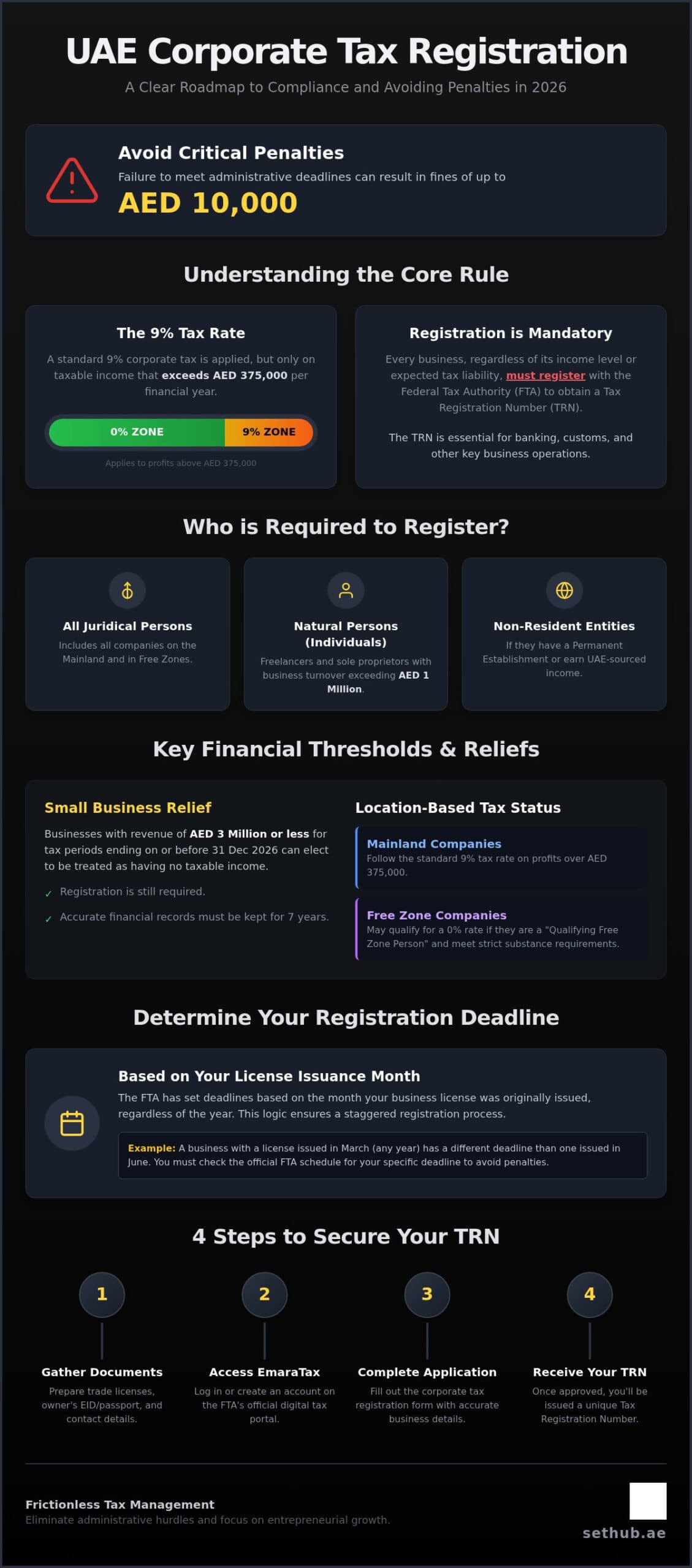
The system operates on a clear “9% Rule.” If your business generates taxable income exceeding AED 375,000 within a financial year, a standard 9% tax rate applies. This threshold is intentionally generous. It ensures that small businesses and startups can grow without immediate fiscal pressure. However, a common misconception is that if you don’t hit this profit mark, you don’t need to do anything. That’s a mistake that leads to heavy penalties. Every business must register, regardless of whether they expect to pay tax or fall under the 0% threshold.
Once registered, you receive a Tax Registration Number (TRN). This unique identifier is more than just a compliance requirement; it’s a vital component of your national business operations. You’ll need it for everything from opening corporate bank accounts to clearing goods through customs. It signals to partners and authorities that your entity is mature, transparent, and fully integrated into the UAE’s modern financial ecosystem.
Who is Required to Register?
The requirement to register is broad, covering nearly every commercial entity operating within the Emirates. This includes all juridical persons, such as Mainland companies and those registered in Free Zones. Even if your Free Zone company qualifies for a 0% rate, the registration step remains mandatory. Natural persons, or individuals, aren’t exempt either; if you’re a freelancer or a sole trader with business turnover exceeding AED 1 million, you must step into the tax net. Non-resident entities also fall under this scope if they maintain a Permanent Establishment or earn income sourced from the UAE.
The Legal Framework: Decree-Law No. 47
The foundation of this system is Federal Decree-Law No. 47 of 2022 on the Taxation of Corporations and Businesses. For a comprehensive overview of taxation in the UAE, it’s helpful to look at how this legislation fits into the broader fiscal history of the region. This specific law became effective on June 1, 2023, marking a historic shift in the country’s economic policy. As we move through 2026, we’re entering a full implementation cycle where businesses with various fiscal year starts are now seeing their first full tax periods come to a close. This makes current compliance more critical than ever.
Determining Your Taxable Status and Exemptions
Understanding where your company fits in the tax landscape is the first step toward peace of mind. While the UAE offers a competitive fiscal environment, “exempt” doesn’t mean “invisible.” To benefit from any tax relief, including the 0% rate for qualifying income, you must first complete your corporate tax registration uae. This is a critical prerequisite. Without a Tax Registration Number, you cannot legally elect for reliefs or prove your exempt status to the authorities.
Certain entities, such as government-controlled organizations, extractive businesses, and qualifying public benefit entities, are considered “Exempt Persons.” For most entrepreneurs, the more relevant category is Small Business Relief. If your revenue is AED 3 million or less for the relevant tax period ending on or before December 31, 2026, you can elect to be treated as having no taxable income. You can find more specific details on these categories in the Official UAE Corporate Tax guide provided by the government. Remember, even if you qualify for this relief, you’re still required to maintain accurate records for seven years.
Free Zone vs. Mainland Tax Implications
Your business’s physical location significantly impacts your tax category. A common misconception is that Free Zones remain entirely “tax-free” without any strings attached. In reality, a Free Zone entity only maintains a 0% rate if it’s a “Qualifying Free Zone Person” meeting strict substance requirements. If you’re currently planning your setup, our Complete Guide to Free Zone Company Registration in the UAE (2026) provides a deeper look at these jurisdictional nuances. Mainland companies, by contrast, follow the standard 9% rate for profits over AED 375,000. Navigating these categories during corporate tax registration uae ensures you don’t overpay or miss out on legitimate savings.
Natural Persons and Freelancers
Individuals conducting business in the UAE are also part of the tax framework. If you’re a freelancer or a sole trader, you must register for corporate tax once your annual turnover exceeds AED 1 million. It’s important to distinguish between your personal salary, which remains untaxed, and your business income. Even non-resident freelancers earning income from UAE sources may find themselves with registration obligations if they meet the turnover threshold. Determining your exact status can feel complex, but it doesn’t have to be. Many successful founders use specialized business setup services to ensure their tax categorization is accurate from day one.
2026 Registration Deadlines and Compliance Timelines
Timing is everything in the current regulatory environment. As we move through 2026, the Federal Tax Authority (FTA) has transitioned from an educational phase to strict enforcement. Your timeline for corporate tax registration uae is determined primarily by the month your trade license was issued. This “License Issuance Month” logic applies regardless of the year the license was granted. It’s a system designed for clarity, but it requires proactive monitoring of your corporate documents to avoid unnecessary friction.
What happens if you hold multiple licenses? The rule is simple and definitive. You must use the issuance date of your oldest license to determine your registration deadline. This ensures that diversified groups don’t fall through the cracks. For businesses incorporated on or after March 1, 2024, the window is even tighter. These entities must complete their registration within three months of their incorporation date. Staying ahead of these dates ensures your operations remain frictionless and your reputation with the authorities stays intact.
Monthly Registration Windows
Your specific deadline depends on your license issuance month. For example, if your license was issued in May, your deadline might differ significantly from a business established in August. To find your exact window and access the latest guides, visit the Federal Tax Authority Corporate Tax Registration portal. Most businesses can verify their issuance date through the National Economic Register or their specific Free Zone authority. If you incorporated in late 2025, your three-month countdown began the moment your license was stamped. Don’t wait for a reminder; the responsibility for compliance rests entirely with the business owner.
Penalty Structures for Non-Compliance
The cost of delay is high and immediate. A fixed administrative penalty of AED 10,000 is imposed for late registration. This isn’t the only risk you face. Missing your window can lead to complications during trade license renewals or even trigger flags with your corporate bank. Banks in the UAE are increasingly vigilant about the tax status of their clients. A missing Tax Registration Number can lead to account freezes or delays in international transfers, making it essential to understand the full corporate bank account requirements in the UAE alongside your tax obligations. If you do receive a penalty, the FTA provides a process for appeals, but it requires rigorous documentation and legal justification. It’s far more efficient to treat registration as a simple checkbox on your path to growth rather than a looming hurdle. Beyond registration penalties, businesses should also be aware that VAT-related errors carry their own serious consequences; using a reliable VAT calculator for UAE tax compliance can help you avoid costly miscalculations and late payment charges.
The Step-by-Step Registration Process on EmaraTax
Registration for corporate tax doesn’t have to be a “black box” experience. The process for corporate tax registration uae is entirely digital, conducted through the Federal Tax Authority’s EmaraTax portal. This platform is designed to consolidate your tax obligations into a single, user-friendly dashboard. While the interface is modern, the quality of your application depends on the accuracy of your initial data entry. Mistakes during the submission phase can lead to avoidable delays or formal requests for clarification, which is why a methodical approach is your best strategy for a frictionless approval.
The system is built on a self-assessment model. You are responsible for identifying your taxable category and providing the evidence to support it. While the government doesn’t charge a fee for the registration itself, the administrative work involved requires precision. Once you submit your application, you can track its progress in real-time. Most businesses receive their Tax Registration Number within 20 business days, provided the documentation is flawless from the start.
Document Checklist for 2026
Success begins with a complete digital folder. For a standard UAE company, you’ll need high-resolution scans of your trade license, the Memorandum of Association (MOA), and identification for all authorized signatories. If you’re managing a branch of a foreign company, you’ll likely need to provide proof of incorporation from your home jurisdiction, often attested by the Ministry of Foreign Affairs. To establish your EmaraTax profile, you must provide your trade license, passport copy, and Emirates ID.
Navigating the EmaraTax Portal
Once your documents are ready, you’ll create and verify an account on the EmaraTax portal. If you’re already registered for VAT, you can often link your corporate tax profile under the same login to simplify your long-term management. One of the most critical steps is selecting your correct “Taxable Person” category. Choosing between a “Juridical Person” or a “Natural Person” dictates your future filing requirements.
You must also be precise when selecting your fiscal year. This date determines exactly when your first tax return is due. Changing it later requires a formal application and specific justifications. Technical hurdles like file size limits or session timeouts can sometimes cause frustration, so ensure all PDF uploads are under 5MB before you begin. If you want to ensure a perfect submission the first time, you can secure your corporate tax registration uae with the help of our in-house specialists.
Frictionless Tax Management with Set Hub
Managing a business in the Emirates is an exciting journey of growth. However, the administrative side shouldn’t slow you down. At Set Hub, we specialize in bridging the gap between your initial company formation and long-term fiscal health. Many entrepreneurs find that corporate tax registration uae is most effective when handled as part of a broader strategy rather than a standalone task. By integrating this milestone into your setup phase, you eliminate the risk of late penalties and ensure your entity is compliant from its first day of operation.
Since 2009, we’ve acted as a seasoned navigator for over 10,000 entrepreneurs. Our expertise isn’t limited to a single jurisdiction; we provide deep insights into both Mainland and Free Zone requirements. When you choose our business setup services in dubai, you gain access to in-house tax and accounting specialists who understand the local landscape intimately. We take the technical burden off your shoulders, allowing you to focus on your vision while we handle the fine print. This synergy between licensing and tax registration is what makes the transition feel routine rather than overwhelming.
Beyond Registration: Total Financial Compliance
Registration is just the beginning of your compliance journey. To maintain your standing with the Federal Tax Authority, you must integrate tax requirements into your annual accounting cycle. This includes precise record-keeping for seven years and timely VAT filings. Our team provides ongoing support that scales with you. Whether you’re expanding within the Emirates or looking toward KSA business setup, having a single strategic partner ensures your financial data remains consistent and your operations stay frictionless. A dedicated PRO and tax consultant can turn complex federal regulations into simple, managed checkboxes on your path to success.
Get Started with Set Hub
Ready to secure your Tax Registration Number without the stress? Our onboarding process is designed to be as simple as possible for both new startups and established firms. We begin with a personalized assessment of your tax category and then manage the entire EmaraTax submission on your behalf. You don’t need to worry about session timeouts or document errors. Let us handle the portal while you handle your business. Register for Corporate Tax with Set Hub Today and experience the relief of expert-led compliance.
Master Your 2026 Tax Compliance Journey
Compliance isn’t just about avoiding an AED 10,000 penalty; it’s about positioning your business for long-term operational success. You now understand that your license issuance month dictates your timeline and that registration remains mandatory regardless of your profit margins. Whether you’re a Mainland entity or a Qualifying Free Zone Person, corporate tax registration uae is the foundation of your fiscal reputation in the Emirates. It’s the final step in transitioning from a new setup to a mature, compliant organization.
Don’t let technical portal hurdles or complex documentation requirements stall your momentum. With over 15 years of UAE consultancy experience, Set Hub provides the seasoned navigation you need to clear every administrative milestone with ease. Our FTA-compliant tax experts handle the heavy lifting, from initial registration to ongoing VAT and accounting support. This comprehensive approach ensures your financial records are audit-ready and your business remains in good standing with federal authorities.
Secure Your Corporate Tax Compliance with Set Hub and turn regulatory requirements into simple checkboxes on your path to success. Your focus should remain on scaling your vision and exploring new markets. Let us handle the complexities of the tax landscape so you can move forward with total peace of mind. Your next chapter of growth starts with a solid, compliant foundation.
Frequently Asked Questions
Is corporate tax registration mandatory for all businesses in the UAE?
Yes, corporate tax registration uae is mandatory for all juridical persons, including Mainland and Free Zone companies. Even if your business qualifies for a 0% tax rate or Small Business Relief, you must notify the Federal Tax Authority of your status. Failure to register by the specified deadline results in immediate administrative penalties, regardless of your annual profit or turnover levels.
What is the deadline for corporate tax registration in 2026?
Your specific deadline is determined by the month your trade license was issued, according to the FTA’s staggered schedule. For businesses incorporated on or after March 1, 2024, the deadline is exactly three months from the date of incorporation. It’s vital to check your oldest license date to find your window, as 2026 marks a period of strict enforcement by the authorities.
Can a Free Zone company be exempt from UAE corporate tax registration?
No, being in a Free Zone doesn’t exempt you from the registration process. While “Qualifying Free Zone Persons” can benefit from a 0% tax rate on qualifying income, they are still required to register and obtain a Tax Registration Number. Registration is the only way to legally claim your 0% status and prove your compliance during future federal audits.
What are the penalties for late corporate tax registration?
The Federal Tax Authority imposes a fixed administrative penalty of AED 10,000 for late registration. Beyond this financial cost, delays can impact your ability to renew trade licenses or maintain corporate bank accounts. Most UAE banks now require a valid Tax Registration Number to keep accounts active, making timely registration a cornerstone of your business’s operational stability.
Do I need a separate TRN for VAT and Corporate Tax?
You’ll use the same EmaraTax account for both, but you receive a specific Tax Registration Number for corporate tax purposes. If you’re already registered for VAT, you can link your profiles within the digital portal for easier management. This consolidation simplifies your dashboard, though you must still manage the distinct filing requirements and deadlines for each specific tax type.
Can I register for corporate tax on my own via EmaraTax?
Yes, any business owner can access the EmaraTax portal to complete their corporate tax registration uae independently. The government provides the portal free of charge for all applicants. However, many entrepreneurs choose a managed service to avoid technical errors or incorrect category selections. Professional support ensures your application is approved without the friction of formal requests for clarification.
What is the minimum income threshold for paying corporate tax in the UAE?
The threshold for paying the 9% standard rate is taxable income exceeding AED 375,000. Income up to this amount is taxed at 0%. Additionally, businesses with revenue below AED 3 million may elect for Small Business Relief. This relief treats taxable income as zero for tax periods ending on or before December 31, 2026, provided you meet all record-keeping requirements.
How long does the corporate tax registration process take?
Most applications are processed within 20 business days once they are submitted through the EmaraTax portal. The timeline can vary depending on the accuracy of your documentation and the current volume of applications at the FTA. Ensuring your trade license, MOA, and identification documents are high-resolution and valid helps speed up the approval flow significantly. Once your Tax Registration Number is secured, your next priority should be ensuring you meet all corporate bank account requirements in the UAE to keep your business operations running without interruption.