


What if the most powerful asset for your business isn’t your marketing strategy, but your relationship with the city’s primary regulator? The dubai economic department, now officially known as the Department of Economy and Tourism (DET), serves as the heartbeat of the mainland economy. In a landscape where Dubai’s GDP has surged to AED 972 billion, securing a mainland license is no longer just a legal step; it’s a strategic move to access the full breadth of the UAE market.
You likely recognize that the regulatory environment is shifting quickly. Between the 2026 mandate for electronic invoicing and the nuanced differences between mainland and free zone jurisdictions, the path to setup can feel daunting. We’re here to strip away that complexity. This reference guide provides a clear roadmap for obtaining your trade license and mastering the latest 2026 regulatory requirements. You’ll gain the clarity needed to choose the right jurisdiction and the confidence to launch a compliant, future-proof enterprise. By the end of this article, the administrative milestones that once felt like hurdles will become simple checkboxes on your path to success.
Key Takeaways
- Support your mainland growth by understanding how the dubai economic department has evolved into the Department of Economy and Tourism (DET).
- Ensure full regulatory compliance by identifying whether a Professional, Commercial, or Industrial license fits your business model.
- Gain unrestricted geographic freedom to trade across the entire UAE by choosing a mainland setup over a free zone.
- Secure your trade name reservation with a clear roadmap for selecting business activities under the latest 2026 guidelines.
- Accelerate your launch by turning complex administrative milestones into simple checkboxes with professional PRO services.
What is the Dubai Economic Department (DED)?
The dubai economic department is the central engine of Dubai’s commercial landscape. If you’re planning to launch a business on the mainland, this government body is your most critical partner. It acts as the primary regulator for all economic activity outside the free zones, ensuring that every enterprise operates within a clear, legal framework. You can explore the Department of Economic Development (DED) history to see how this institution has grown alongside the city itself. Today, it isn’t just about oversight; it’s about empowerment. The department is the lead architect of the Dubai Economic Agenda (D33), which aims to double the size of Dubai’s economy by 2033. For an entrepreneur, this translates to a proactive environment where regulation is designed to support growth rather than hinder it.
The Evolution from DED to DET
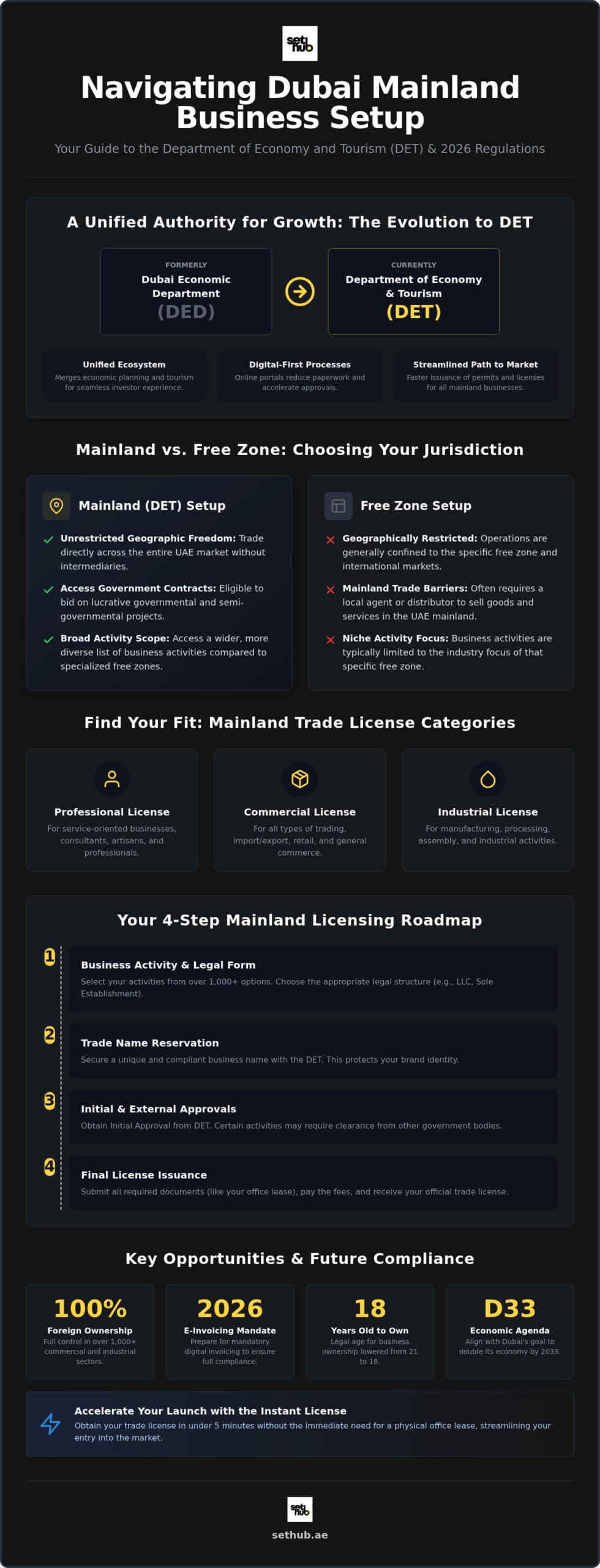
In a strategic move to unify the city’s growth drivers, the department evolved into the Department of Economy and Tourism (DET). This consolidation wasn’t just a name change; it merged economic planning with tourism development to create a seamless ecosystem for investors. By 2026, this integration has significantly simplified the path to market. You no longer have to navigate separate silos for commercial permits and tourism-related approvals. The new structure has streamlined the issuance of permits, making the process faster and more digital-centric. The 2026 regulatory landscape emphasizes digital-first interactions, meaning most mandates are now fulfilled through sophisticated online portals that reduce manual paperwork. This unified approach ensures that commercial regulations stay agile, reflecting the fast-paced needs of a modern global hub.
Core Mandate for Mainland Business Owners
Every mainland entity must maintain a direct relationship with the department to remain compliant and operational. Their mandate covers several essential pillars of business life. They act as the “Sophisticated Facilitator,” turning complex legal requirements into manageable steps for the business owner.
- Licensing Authority: They are the sole body responsible for issuing, renewing, and amending trade licenses for all mainland companies.
- Commercial Ethics: The department enforces strict standards for consumer protection and fair competition, maintaining the integrity of the marketplace.
- Registry Management: They manage the city’s commercial register and trade name database, ensuring your brand identity is unique and legally protected.
Interacting with the dubai economic department is a mandatory milestone for every mainland founder. It’s the authority that validates your legal existence in the UAE. By centralizing these functions, the department ensures that your business journey starts on solid ground with all the necessary legal protections in place.
Key Functions and Business Licensing Services
The dubai economic department serves as the primary architect for your mainland growth. Its efficiency is reflected in the World Bank’s Doing Business report, which highlights the UAE’s competitive regulatory environment. Beyond simple registration, the department manages the entire lifecycle of your company. This includes processing license amendments, managing temporary license freezes, and handling formal cancellations when a business concludes its journey. Perhaps the most empowering shift is their facilitation of 100% foreign ownership. You can now retain full control of your commercial or industrial entity without the traditional requirement for a local majority shareholder, provided your activity falls within the approved list of over 1,000 sectors. The department has also modernized accessibility by lowering the legal age for business ownership from 21 to 18 years old, opening doors for a new generation of founders. This supportive framework is designed to turn administrative milestones into simple checkboxes on your path to success.
Trade License Issuance and Categories
Choosing the right category is vital for a frictionless launch. The department classifies licenses into three primary streams: Professional, Commercial, and Industrial. Each requires precise activity codes to ensure legal compliance and avoid potential fines. The Instant License option in 2026 enables entrepreneurs to obtain their legal documentation in under five minutes without the immediate requirement of a physical office lease. If you’re unsure which path fits your vision, you can calculate your setup costs online to see how managed support simplifies the journey.
Commercial Compliance and Consumer Protection
The dubai economic department ensures every activity aligns with national safety and ethical goals. They regulate commercial ethics to ensure fair competition and protect both buyers and sellers. If a dispute arises, the DET provides official channels for resolution to bypass immediate litigation. Regular inspections verify that mainland shops follow price transparency and quality standards. These measures maintain Dubai’s reputation as a premium marketplace and protect your brand’s integrity.
Understanding these functions allows you to navigate the regulatory landscape with confidence. The department acts as a strategic partner, offering the tools and protections necessary for long-term stability. By leveraging their digital-first services, you can focus on scaling your operations while the DET maintains the integrity of the business environment. This balance of oversight and empowerment is what makes the mainland a preferred destination for global investors.
Choosing Mainland: DED vs. Free Zone Jurisdictions
Deciding between a mainland setup and a free zone is the first major fork in the road for any entrepreneur. While free zones offer specific tax carve-outs, a license from the dubai economic department unlocks the entire UAE market without restriction. This geographic freedom is the primary differentiator. If your business model relies on local retail, distribution, or providing services directly to UAE residents, the mainland is your logical destination. You aren’t confined to a specific district; you can lease office space anywhere in Dubai, from the bustling streets of Deira to the modern towers of Business Bay. This flexibility allows you to position your brand exactly where your customers are.
The strategic advantage extends beyond location. Mainland companies are uniquely eligible to bid for lucrative government contracts and large-scale tenders. In 2026, as Dubai continues to expand its infrastructure and digital services, these public sector opportunities are significant growth drivers. Unlike free zone entities that often require a local distributor to trade on the mainland, a DED-licensed company deals directly with its customers. This removes the middleman and protects your profit margins. It’s a setup designed for those who want to be fully integrated into the city’s economic fabric. For a detailed breakdown of how these two jurisdictions compare on banking success and tax efficiency, see our guide on company formation in Dubai: mainland vs. free zone comparison for 2026.
Benefits of a Mainland Trade License
A mainland trade license provides a level of operational agility that free zones cannot match. You have the freedom to operate across the national territory, including other emirates, without additional licensing. This is essential for logistics, construction, and retail businesses. Your visa quota is also directly tied to your office space. This allows you to scale your workforce as your physical footprint grows. The dubai economic department provides a transparent framework for these quotas, ensuring you can hire the talent needed to meet demand as you expand.
Ownership and Geographic Flexibility
The regulatory landscape has shifted significantly in favor of the investor. Under the latest 2026 guidelines, most commercial and industrial activities now allow for 100% foreign ownership on the mainland. This removes the traditional requirement for a local sponsor, giving you full legal and operational control. For a deeper look at these shifts, see our Company Formation in UAE: The 2026 Strategic Entrepreneurial Guide. You can also verify specific activity requirements directly through the Dubai Department of Economy and Tourism (DET) portal. This flexibility makes the mainland the gold standard for businesses aiming for long-term stability and growth within the local economy.
Navigating the DED Licensing Process in 2026
Launching your venture on the mainland requires a clear, step-by-step approach. The dubai economic department has refined this journey into five distinct milestones to ensure speed and clarity. First, you’ll select your specific business activities and the appropriate legal structure, such as a Limited Liability Company (LLC). This choice is foundational. It dictates your licensing path and future tax obligations. Next, you’ll reserve a trade name and obtain initial approval. Drafting the Memorandum of Association (MOA) follows, defining how your company is governed. You’ll then secure a physical office space to obtain your Ejari, which is the registered lease contract. Finally, you’ll submit all documents for the final license issuance and settle the required fees. This logical progression turns a potentially complex transition into a routine series of simple checkboxes.
Trade Name Reservation and Initial Approval
Your business name is your first impression in the market. To ensure acceptance, avoid using religious terms, names of global brands, or offensive language. The dubai economic department maintains strict naming conventions to protect the integrity of the marketplace. Initial approval acts as the department’s green light, confirming that the government has no objection to your business existing. In 2026, an initial approval remains valid for a period of six months from the date of issuance. This window gives you ample time to finalize your lease and legal drafting without the pressure of a looming deadline.
Documentation and Legal Requirements
Preparing your dossier correctly prevents friction and unnecessary delays. For individual founders, you’ll need passport copies, visa pages, and Emirates IDs. If a corporate entity is a shareholder, the requirements are more rigorous. You’ll provide attested certificates of incorporation and board resolutions from the parent company. The Notary Public plays a vital role here. They must witness the signing of the MOA to make it legally binding in the UAE. If you’re establishing a professional entity, you might draft a Local Service Agent (LSA) agreement instead. Managing these legal nuances can be complex, but you can get expert assistance for your mainland setup to ensure every document is perfect.
Success in this phase depends on precision and foresight. Understanding the financial commitment early on is essential, so review our Cost of Setting Up a Business in Dubai: 2026 Comprehensive Price Guide to budget effectively. Once your Ejari is registered and the final fees are settled, the department issues your trade license. This document is your passport to the mainland market, signaling that you’re ready to trade, hire, and grow in one of the world’s most dynamic economies. With your license in hand, the focus shifts from administrative setup to active entrepreneurial growth.
Streamlining Your Mainland Setup with Set Hub
Mastering the requirements of the dubai economic department is just the first chapter of your success story. While the DET has modernized its portals, the administrative reality of 2026 involves more than just a trade license. You must now account for mandatory electronic invoicing starting July 2026 and rigorous new VAT supplier checks. Set Hub acts as your seasoned navigator, transforming these complex regulatory hurdles into a managed, frictionless flow. We don’t just provide a service; we act as a strategic partner to ensure your mainland company is built on a foundation of total compliance from day one. Our approach prioritizes your peace of mind, allowing you to experience the excitement of a new beginning without the friction of administrative delays.
Expert PRO and Documentation Support
Our team has assisted over 10,000 entrepreneurs in navigating the local business landscape since 2009. We handle the heavy lifting of legal translations and government interactions, ensuring your application meets every 2026 commercial law standard. This includes staying ahead of niche regulations, such as the new music licensing fees or the final phase of the single-use plastic ban. By fast-tracking your approvals, we remove the complexity of dealing with multiple government departments. We treat every administrative milestone as a simple checkbox on your path to success. This veteran expertise ensures that your interaction with the dubai economic department is efficient and error-free, preventing the costly setbacks that often plague unguided applications.
Beyond the License: Banking and Tax
Operational readiness requires more than a certificate on the wall. We bridge the gap between registration and active trading by facilitating corporate bank account opening and managing your corporate tax and VAT registration. The 2026 landscape demands a sophisticated approach to financial compliance, and we ensure your entity is ready for the latest FTA requirements. If your goal is long-term residency, we seamlessly connect your mainland license to Golden Visa solutions for you and your family. This holistic care ensures that your transition from a prospect to a fully operational business owner is smooth and logical. For a complete look at this journey, see our Starting a Business in Dubai: The Complete 2026 Entrepreneurial Guide.
Choosing the mainland is a visionary step toward unlimited growth. By partnering with a sophisticated facilitator, you gain more than just a license; you gain a roadmap for long-term stability. We manage the end-to-end documentation so you can focus on scaling your operations. From the initial trade name reservation to the final visa issuance, we ensure every step is handled with reassuring efficiency. Your mainland success is our primary objective, and we provide the expert-led support necessary to turn your entrepreneurial vision into a thriving reality.
Turning Regulatory Complexity into Commercial Advantage
Securing a license from the dubai economic department is more than a legal necessity; it’s a strategic move into a market targeting massive growth under the D33 agenda. You’ve discovered how mainland setups offer the geographic freedom to trade across the entire UAE and the exclusive right to bid for government contracts. As the 2026 landscape introduces new digital mandates like e-invoicing, proactive compliance is your most valuable asset for long-term stability.
Since 2009, we’ve served as a seasoned navigator for more than 10,000 entrepreneurs across the UAE and KSA. Our team provides full PRO and documentation management to ensure your launch is frictionless and fast. We handle the intricacies of the Department of Economy and Tourism so you can focus on building your brand. Launch your mainland business with Set Hub’s expert support and step into the future of Dubai commerce with total confidence. Your entrepreneurial journey is just beginning, and the city’s momentum is on your side.
Frequently Asked Questions
What is the main difference between DED and free zone licenses?
The primary difference lies in geographic trading rights and operational scope. A license from the Department of Economy and Tourism (DET) allows you to trade anywhere in the UAE and bid for government contracts directly. Free zone licenses generally restrict your physical operations to the specific zone and international markets. Mainland companies also enjoy more flexibility in choosing office locations across the city rather than being confined to a designated district.
Can I own 100% of my mainland company as a foreigner in 2026?
Yes, 100% foreign ownership is now the standard for most commercial and industrial activities on the mainland. The UAE government removed the requirement for a local majority shareholder for over 1,000 business activities. This allows you to maintain full legal and operational control of your entity. You can verify if your specific activity qualifies for full ownership through the dubai economic department portal or by consulting with a seasoned setup expert.
How long does it take to get a trade license from the Economic Department?
Processing times depend on your license type, but an Instant License can be issued in under five minutes. Standard mainland licenses typically take between three to five working days once all documentation is finalized. This timeline includes reserving your trade name and obtaining initial approval. Working with a professional PRO service can fast-track these steps by ensuring your paperwork is error-free and compliant with the latest 2026 regulatory standards from the start.
What are the costs associated with a DED mainland license?
Total costs depend on your business activity, legal structure, and office requirements. You should budget for trade name reservation fees, initial approvals, and the mandatory market fee, which is a percentage of your annual office rent. There are also administrative service fees and costs for drafting legal documents like the Memorandum of Association. Because every setup is unique, using a cost calculator is the most efficient way to get a personalized estimate for your vision.
Do I need a local partner for a mainland business setup?
Most commercial and industrial businesses no longer require a local Emirati partner holding 51% of shares. You can typically enjoy full ownership and control. However, professional licenses for specific consultancy services may still require a Local Service Agent (LSA). The LSA does not own equity in your company; they facilitate government interactions and administrative tasks for a fixed annual fee. This ensures you retain 100% of the profits and operational decision-making power.
What is an Instant License and who is eligible for it?
The Instant License is a streamlined option that allows entrepreneurs to secure their legal documentation in a single step without an immediate office lease. It’s available for most commercial and professional activities that don’t require external government approvals. This license is valid for one year, giving you time to establish your physical presence. It significantly reduces the friction of starting a business with the dubai economic department by consolidating multiple steps into one digital application.
Is a physical office mandatory for a DED mainland license?
A physical office is generally mandatory for mainland companies to obtain an Ejari, which is the registered lease contract. However, the Instant License allows you to bypass this requirement for the first year of operation. After this initial period, you must secure a physical workspace to renew your license. This requirement ensures that mainland businesses have a verifiable base for inspections, banking requirements, and the issuance of employee visas as the company grows.
Can a mainland company operate in UAE free zones?
Yes, a mainland company can trade within UAE free zones and across all seven emirates without additional licensing. This is a significant advantage over free zone entities, which face restrictions when trading outside their specific jurisdiction. Mainland businesses can also bid for government contracts in any part of the country. This setup provides the ultimate flexibility for companies aiming for nationwide market penetration and direct access to the local UAE consumer base.