


Did you know that your second year of operations in Saudi Arabia could cost five times more in licensing fees than your first? When calculating the business setup cost in saudi arabia, most entrepreneurs focus exclusively on the initial launch, but the real challenge lies in navigating a shifting fee structure that often catches the unprepared off guard. It’s understandable if you’re feeling overwhelmed by opaque government charges or the fear of bureaucratic delays during your MISA licensing. You’re looking for a predictable path to market entry, not a series of expensive surprises.
This 2026 guide provides the financial clarity you need to move from uncertainty to a successful launch. We’ll break down the specific costs for MISA licenses, commercial registrations, and mandatory office space requirements in UAE Dirham (AED). You’ll gain a clear roadmap for frictionless corporate bank account opening and long-term compliance, ensuring your expansion into the Kingdom is as efficient as it is profitable. By the end of this article, you’ll have a mastered budget that turns administrative milestones into simple checkboxes on your path to growth.
Key Takeaways
- Understand how Vision 2030 and the MISA framework now permit 100% foreign ownership across most sectors, simplifying your entry into the Kingdom.
- Master the total business setup cost in saudi arabia with a detailed Phase 1 and Phase 2 fee breakdown, converted into AED for your convenience.
- Evaluate the specific capital requirements and operational differences between establishing an LLC or a Foreign Branch Office in 2026.
- Identify the essential compliance milestones, from digital notarization of your Articles of Association to navigating the complexities of ZATCA e-invoicing.
- Gain professional insights on bypassing common delays in corporate bank account opening to ensure your business is transaction-ready from day one.
The 2026 Landscape of Saudi Arabia Company Formation
The Kingdom’s economic transformation has reached a pivotal maturity point. In 2026, the business setup cost in saudi arabia reflects a highly digitized, transparent, and investor-friendly environment. Saudi Arabia is no longer just an emerging market; it’s a global hub where bureaucratic friction has been replaced by the Saudi Business Center (SBC). This “one-stop shop” integrates over 40 government entities, allowing you to handle everything from name reservation to tax registration through a single digital interface. For entrepreneurs moving from the UAE, this level of integration mirrors the efficiency of Dubai’s free zones but on a massive, G20-scale mainland stage. If you are starting your journey in the Emirates, you might want to discover more about Mainland Company Formation to understand the full scope of regional opportunities.
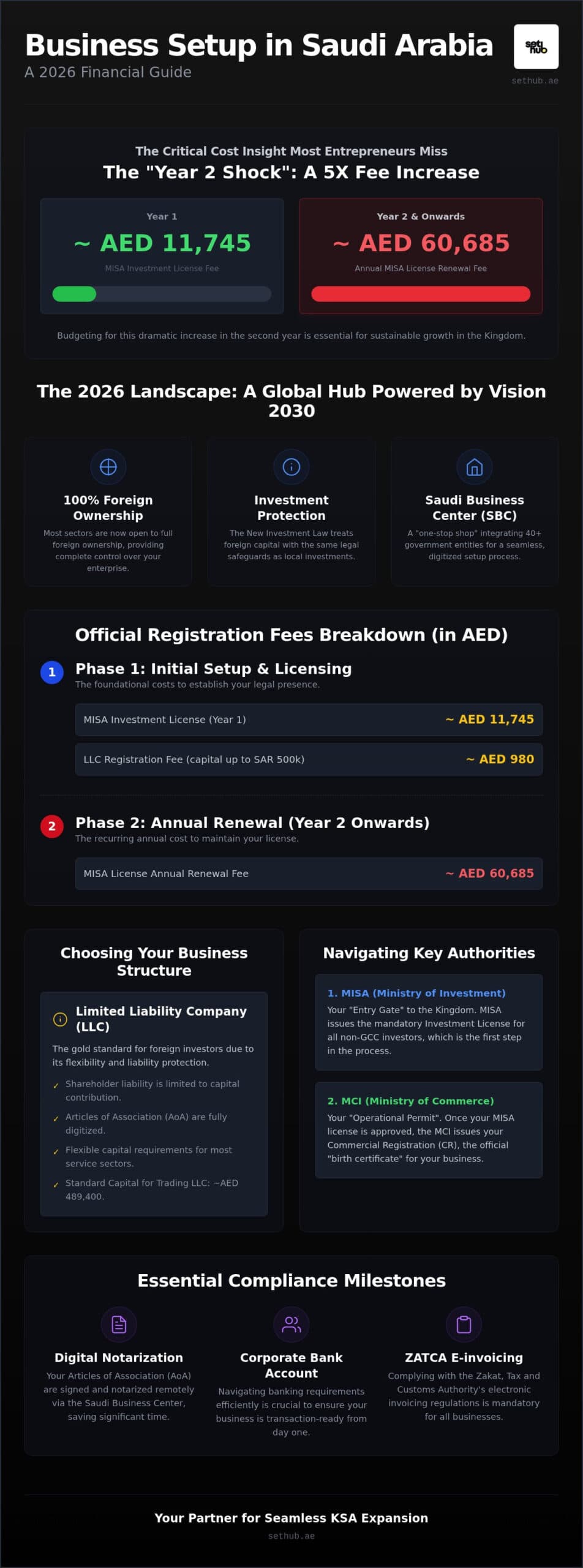
The current year represents a golden window for entry. The government has aggressively reduced entry barriers to meet Vision 2030 targets, aiming to increase SME contribution to the GDP from 20% to 35%. This push has led to significant fee reductions for new entities. For example, as of January 2026, the initial registration fee for a Limited Liability Company (LLC) with capital up to AED 489,000 (SAR 500,000) is now only about AED 980. These strategic adjustments make the initial business setup cost in saudi arabia more accessible than ever for regional startups and international firms alike.
Vision 2030 and Foreign Investment Protections
Security is the foundation of the 2026 framework. The New Investment Law provides legal safeguards that treat foreign capital with the same protections as local investments. This includes the right to 100% foreign ownership in most sectors and the freedom to repatriate profits without restriction. The Economy of Saudi Arabia is diversifying rapidly, and the government offers specific incentives for technology, manufacturing, and tourism. If you’re looking for long-term stability, the Regional Headquarters (RHQ) program even offers a 0% corporate income tax rate for 30 years, provided you manage your MENA operations from the Kingdom.
MISA vs. MCI: Navigating the Two Pillars
Establishing your presence requires coordinating between two primary authorities. Think of MISA as your entry gate and the MCI as your operational permit. Understanding their distinct roles is vital for a frictionless launch:
- MISA (Ministry of Investment): This is the first stop for all non-GCC investors. They issue the Investment License, which is the prerequisite for any foreign-owned business. The first-year license fee is approximately AED 11,745.
- MCI (Ministry of Commerce): Once you have your MISA license, the MCI issues your Commercial Registration (CR). This is your official “birth certificate” in the Saudi market.
While the first year is cost-effective, you must budget for the “Year 2 Shock.” The MISA renewal fee increases to roughly AED 60,685 annually starting in the second year. Mastering these nuances early ensures your budget remains predictable as you scale.
Evaluating Business Structures and Capital Requirements
Choosing the right legal vehicle is the most critical decision in your expansion strategy. It dictates your tax obligations, your ability to hire, and your long-term business setup cost in saudi arabia. While the regulatory environment has become significantly more transparent, the “correct” structure depends entirely on your commercial goals. Most international investors opt for the Limited Liability Company (LLC) due to its scalability, but for those testing the waters, a Branch Office or a Representative Office might offer a more tailored entry point.
The LLC Model: 100% Foreign Ownership
The LLC is the gold standard for foreign investors in the Kingdom. It provides a robust shield for shareholders, limiting liability to the extent of their capital contribution. In 2026, the process of drafting and signing the Articles of Association (AoA) has been fully digitized. You no longer need to fly to Riyadh for physical notarization; the Saudi Business Center allows for remote digital signatures, slashing weeks off the traditional timeline. If you’re unsure which structure fits your five-year plan, using a business setup cost calculator can help you visualize the long-term financial commitments of each model.
Share capital requirements in 2026 are remarkably flexible for many service sectors. While a standard trading LLC often maintains a capital of approximately AED 489,400 (SAR 500,000), the Ministry of Investment often allows “flexible capital” structures for professional services. This means you don’t necessarily have to deposit the full amount into a local bank account immediately, though the capital must be stated in your Commercial Registration. You can verify the latest sector-specific requirements through the official Invest Saudi portal to ensure your planned capital matches current mandates.
Branch Office vs. Subsidiary Cost Implications
A Foreign Branch Office is an extension of your parent company rather than a separate legal entity. This structure is often faster to activate because it relies on the parent company’s track record. However, it carries a unique tax profile. Unlike a subsidiary (which is a standalone LLC), a branch’s profits are often scrutinized more closely regarding home-office expenses. For 2026, the registration fee for a Foreign Company Branch has been reduced to approximately AED 11,745 (SAR 12,000) to encourage more multinational presence.
- Subsidiary (LLC): Best for those seeking a local identity and the highest level of liability protection.
- Foreign Branch: Ideal for project-specific contracts or companies with a strong existing global brand.
- Representative Office: A low-cost, non-commercial option. You can’t issue invoices or earn profit, but you can hire staff for market research and technical support.
Regulatory reporting is a non-negotiable part of your business setup cost in saudi arabia. Whether you choose a branch or an LLC, you’ll need to budget for annual audits and ZATCA filings. While a branch might seem simpler, it often requires more complex accounting to satisfy both Saudi and home-country tax authorities. Decisions made today regarding your structure will define your operational ease for years to come.
Step-by-Step Breakdown of Official Registration Fees
Establishing a presence in the Kingdom is no longer a test of patience; it’s a test of precision. The official business setup cost in saudi arabia is divided into logical phases, each requiring specific financial and administrative commitments. While the process is faster than ever, your budget must account for both government fees and the secondary costs of compliance. The World Bank’s Doing Business 2020 report highlighted that Saudi Arabia’s accelerated reforms have made it one of the most improved economies for entrepreneurs, a trend that has only strengthened in 2026.
To keep your launch on track, follow this five-phase fee structure:
- Phase 1: MISA License and Name Reservation: You’ll start by securing your Investment License. The initial fee is approximately AED 11,745, which includes the issuance and a mandatory first-year subscription.
- Phase 2: Articles of Association (AoA): Your legal foundation is laid here. Digital notarization through the Saudi Business Center has replaced physical visits, though you should budget for professional drafting to ensure compliance.
- Phase 3: Commercial Registration (CR) and Chamber of Commerce: The CR fee is roughly AED 1,175 for most LLCs. You’ll also pay a mandatory Chamber of Commerce membership fee, typically around AED 2,155 depending on your company grade.
- Phase 4: Municipality Permits and National Address: Every business needs a verified physical location. Registering your National Address with Saudi Post costs AED 980 annually, while municipality permit fees vary by office size and activity.
- Phase 5: GOSI and ZATCA Registrations: Finalize your tax profile with ZATCA and register with GOSI for social insurance. While these registrations don’t have an upfront “fee,” they activate your ongoing tax and labor obligations.
Document Preparation and Attestation Costs
Your journey begins long before you log into a Saudi portal. You must prepare board resolutions, financial statements, and parent company documents. These require cross-border legalization, often involving the Saudi Embassy in your home country and the Ministry of Foreign Affairs. Attestation costs can add up quickly, often ranging between AED 3,000 and AED 7,000. Professional PRO services are highly recommended here; they reduce the friction of international document handling and prevent the costly mistake of a rejected application due to improper stamps.
The Digital Journey: Navigating Government Portals
Success in 2026 depends on mastering the MISA electronic portal. Most delays aren’t caused by government slow-downs but by data entry errors or incomplete uploads. Ensure your digital files are perfectly aligned with your MISA license activity to avoid a restart. You’ll also need to subscribe to the Qiwa platform for labor management, which costs between AED 1,240 and AED 2,590 annually. The Commercial Registration serves as the legal birth certificate of the company. Once this is issued, you’re officially part of the Saudi economy and ready to hire your first team members.
Operational Readiness: Budgeting for Compliance and HR
Securing your Commercial Registration is a victory, but it’s only the beginning of your operational journey. The true business setup cost in saudi arabia includes the vital steps of becoming transaction-ready and legally compliant with labor laws. Opening a corporate bank account remains the most significant post-incorporation hurdle. Banks require a verified physical office lease registered on the Ejar portal before they’ll even review your application. You can’t skip this. Without a local account, you can’t pay your employees or settle your taxes, making this a non-negotiable budget item for your first 90 days.
Taxation and ZATCA E-Invoicing (Fatoora)
Your financial planning must account for the Kingdom’s specific tax environment. Foreign investors are subject to a 20% corporate income tax on profits. This is a distinct shift from the UAE’s tax structure, so professional corporate tax and VAT registration is essential to avoid penalties. Compliance also means integrating with ZATCA’s Phase 2 e-invoicing (FATOORA) system. You’ll need to budget for compatible accounting software that links directly to government portals for real-time reporting. Don’t forget withholding tax; payments made to non-resident service providers are typically taxed at rates between 5% and 15%.
Human Resources and the Qiwa Platform
Managing a workforce in Saudi Arabia requires navigating the Qiwa and Mudad platforms. These digital hubs handle everything from employee contracts to salary transfers. You’ll also need to master the Nitaqat system, which sets Saudization ratios based on your industry and company size. Maintaining a “Green” or “Platinum” status is mandatory to renew licenses and issue new visas. Budgeting for your leadership team is also a factor. The residency cost (Iqama) for a General Manager is approximately AED 9,295 annually, while each foreign employee carries a work permit levy of roughly AED 9,395 per year.
Does this feel like a lot to manage at once? It doesn’t have to be. If you’re ready to simplify your transition, our experts can handle your KSA business setup from start to finish, ensuring every compliance checkbox is marked. We turn these complex regulatory requirements into a managed, predictable flow so you can focus on your market strategy instead of paperwork.
Set Hub: Your Partner for Seamless KSA Expansion
Expanding into the Kingdom shouldn’t feel like a leap into the unknown. Set Hub acts as your seasoned navigator in a landscape that’s rapidly evolving. We’ve spent 15 years mastering the regional business environment. Since 2009, our team has helped over 10,000 entrepreneurs bridge the gap between a vision and a fully operational entity. We know that the business setup cost in saudi arabia is more than just a collection of government fees. It’s a strategic investment that requires local expertise to optimize. Our team specializes in 100% foreign ownership structures, handling everything from initial MISA licensing to finding the perfect office space so your entry is as frictionless as possible.
We don’t just process applications; we act as your strategic partner for growth. Our “Sophisticated Facilitator” approach means we anticipate regulatory shifts before they impact your operations. Whether it’s navigating the latest 2026 ZATCA requirements or coordinating with the Ministry of Commerce for your Commercial Registration, we simplify the transition. You’ll move quickly from identifying a market need to executing an actionable path forward. We treat administrative milestones not as hurdles, but as simple checkboxes on your path to a larger goal.
Why UAE-Based Businesses Choose Set Hub
Many of our clients begin their journey in the Emirates before looking toward Riyadh or Jeddah. We provide a unified consultancy for multi-jurisdiction expansion across the GCC. If you’ve already utilized our Complete Guide to Free Zone Company Registration in the UAE (2026), you’re familiar with our commitment to transparency. We build customized roadmaps that bridge UAE and KSA compliance standards. This ensures your corporate structure remains cohesive and your cross-border operations stay efficient. We manage the complexity so you can focus on the excitement of new beginnings and entrepreneurial growth.
Get Started with a Frictionless Consultation
Financial uncertainty is often the biggest barrier to international growth. Our Business Setup Cost Calculator removes the guesswork by providing data-driven insights tailored to your specific activity and scale. We promise speed, transparency, and expert-led growth from day one. You deserve a partner who is deeply rooted in the local business environment and acts as an insider to make complex transitions feel routine. Don’t let opaque fee structures or bureaucratic delays hold your business back. Start your Saudi Arabia expansion with Set Hub today and turn your regional ambitions into a profitable reality.
Secure Your Commercial Future in the Kingdom
Mastering the business setup cost in saudi arabia is about more than just numbers; it’s about building a foundation for regional success. You’ve seen how the 2026 landscape favors the prepared, from the digitized MISA licensing process to the strategic selection of an LLC or Branch structure. By accounting for Phase 2 ZATCA compliance and the nuances of the Nitaqat system early, you transform potential hurdles into predictable steps. The Kingdom’s Vision 2030 isn’t just a plan; it’s a living opportunity for entrepreneurs ready to move with precision.
Since 2009, we’ve helped over 10,000 entrepreneurs navigate these transitions with ease. Our specialist cross-border KSA-UAE setup team understands the unique challenges of expansion and provides end-to-end support, from licensing to corporate banking. You don’t have to face the regulatory complexity alone. Start your Saudi Arabia expansion with Set Hub today and experience a frictionless entry into one of the world’s most dynamic markets. Your next chapter of growth is ready to begin.
Frequently Asked Questions
Can a foreigner own 100% of a company in Saudi Arabia in 2026?
Yes, foreign investors can now own 100% of their business in the majority of sectors under the Vision 2030 framework. This reform removes the previous requirement for a local Saudi partner, allowing international founders to maintain full equity and operational control. Some specific sectors like upstream oil and gas or certain military activities remain restricted, but most commercial and service industries are fully open to foreign capital.
What is the minimum capital required for a Saudi LLC for foreigners?
The standard minimum share capital for a trading LLC is typically AED 489,400, which is equivalent to SAR 500,000. For service based entities, the Ministry of Investment often allows for more flexible capital requirements. It is vital to include this capital injection when calculating your total business setup cost in saudi arabia, as it defines your initial liquidity and financial standing in the local market.
How long does it take to register a company in Saudi Arabia as a foreigner?
The registration process generally takes between 4 to 8 weeks to reach full operational readiness. Thanks to the Saudi Business Center’s digital integration, the timeline for securing a MISA license and Commercial Registration has been significantly reduced. However, post incorporation steps like opening a corporate bank account and registering a physical office lease via the Ejar portal can add several weeks to the final timeline.
What is a MISA license and why is it mandatory?
A MISA license is a mandatory investment permit issued by the Ministry of Investment of Saudi Arabia for all non GCC investors. It serves as your primary legal authorization to operate and own assets within the Kingdom. Without this license, a foreign entity cannot obtain a Commercial Registration or hire employees. It acts as the gatekeeper for foreign capital, ensuring all international businesses align with national economic standards.
Do I need a local Saudi partner to start my business?
No, you do not need a local Saudi partner for the vast majority of business activities in 2026. The shift toward 100% foreign ownership has made the “silent partner” model obsolete for most entrepreneurs. You can now establish a Limited Liability Company or a Foreign Branch Office with full international ownership, providing you with complete autonomy over your corporate decisions and profit distribution.
What are the tax obligations for foreign-owned companies in KSA?
Foreign owned companies are subject to a 20% corporate income tax on their annual net profits. This is a significant consideration for your ongoing business setup cost in saudi arabia compared to some neighboring jurisdictions. Additionally, companies must register for a 15% Value Added Tax (VAT) with ZATCA and adhere to the mandatory e-invoicing regulations. Social insurance contributions through GOSI also apply to your workforce.
Can I open a corporate bank account in Saudi Arabia remotely?
No, opening a corporate bank account typically requires the physical presence of the company’s General Manager for KYC procedures. Saudi banks also mandate a verified physical office lease registered on the Ejar portal before they will approve an application. While the initial company registration is almost entirely digital, the final banking step remains a high touch process that requires local documentation and a personal visit to the branch.
Is it easier to set up in KSA if I already have a UAE company?
Yes, having an established UAE company can streamline the document attestation and track record verification process. MISA often looks favorably upon GCC based entities expanding into the Kingdom because they already understand regional compliance. Using a specialist cross border team can help you bridge the regulatory gap between the two markets, ensuring your parent company documents are correctly legalized and accepted by Saudi authorities without delay.