


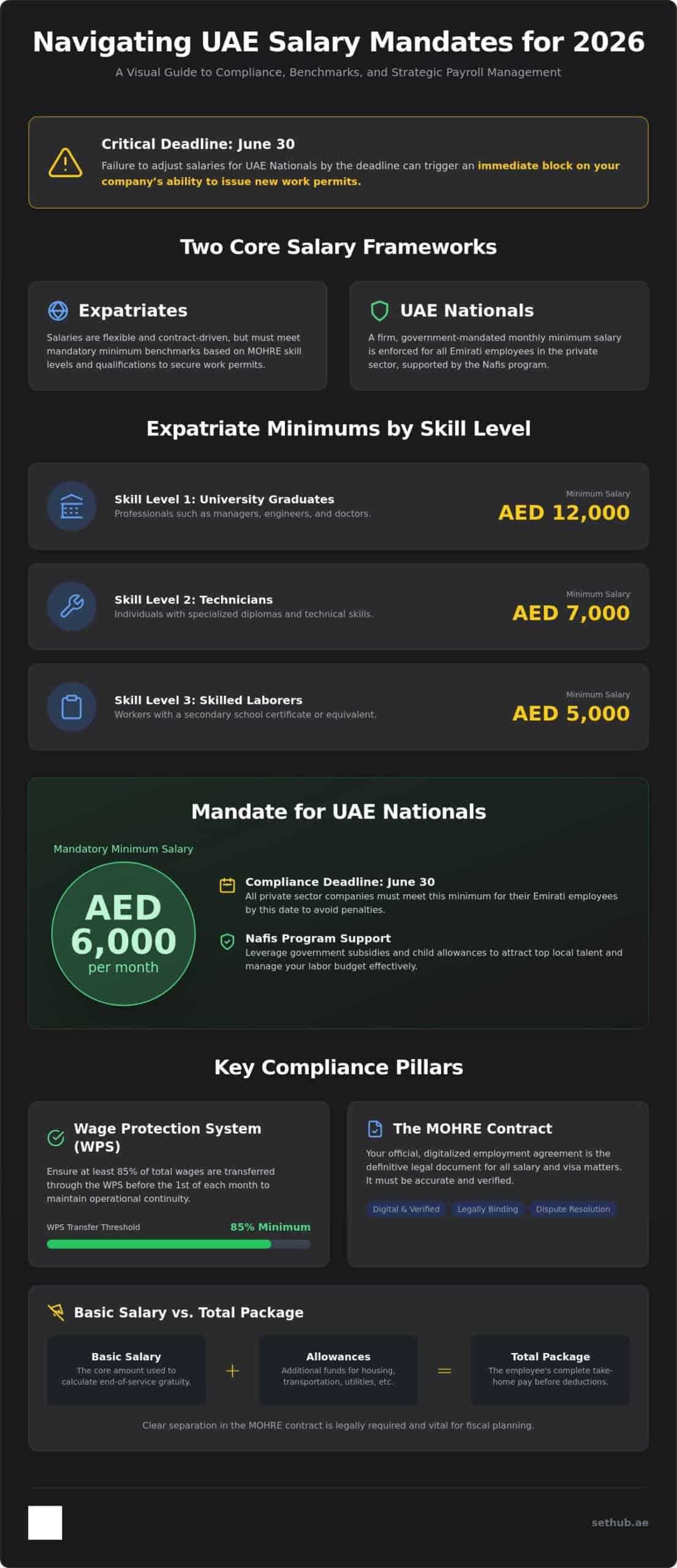
Did you know that failing to adjust a single salary by the June 30 deadline could trigger an immediate block on your company’s ability to hire new talent? It’s a high-stakes environment for employers this year. You’re likely feeling the pressure of balancing a competitive payroll with the strict new mandates for the minimum salary in dubai 2026. While the rules for expatriates remain contract-driven, the landscape for UAE nationals has shifted to a firm AED 6,000 monthly floor.
Managing these multi-tiered regulations doesn’t have to be a source of stress. We’ll show you exactly how to navigate the 2026 UAE labor laws, from meeting the 85% Wage Protection System (WPS) threshold to leveraging Nafis subsidies for your team. This guide provides a clear roadmap to keep your business compliant, your staff paid on time, and your growth trajectory uninterrupted.
Key Takeaways
- Distinguish between flexible expatriate salary contracts and the mandatory qualification-based benchmarks required for skilled work permits.
- Ensure full compliance with the mandatory minimum salary in dubai 2026 of AED 6,000 for Emirati nationals by the June 30 deadline to avoid permit blocks.
- Maintain operational continuity by transferring at least 85% of total wages through the Wage Protection System (WPS) before the first of each month.
- Leverage Nafis program subsidies and child allowances to attract top local talent while managing your total labor budget effectively.
- Align your company registration structure with current labor laws to simplify visa quotas and ensure frictionless administrative renewals.
Understanding the Minimum Salary Framework in the UAE for 2026
Many entrepreneurs arrive in the Emirates expecting a single, fixed number for the minimum salary in dubai 2026. In reality, the UAE operates a sophisticated, multi-tiered system. There isn’t a flat federal minimum wage that applies to every expatriate worker across the board. Instead, the Ministry of Human Resources and Emiratisation (MOHRE) regulates pay through specific benchmarks based on education, job roles, and nationality. This approach ensures the market remains flexible while protecting the rights of the diverse workforce.
The legal foundation for these rules is built upon the UAE labor law for migrant workers, which emphasizes transparency and mutual agreement between employer and employee. For 2026, the government has sharpened its focus on “fair compensation.” This isn’t just about legal compliance; it’s a strategic move to attract the world’s best talent by ensuring that total packages reflect the true cost of living and professional value. It makes the city a premium destination for global experts.
The Role of Labor Contracts and MOHRE
The MOHRE employment contract is your most important legal document. It serves as the definitive point of reference for all salary disputes and visa stability. If a figure isn’t recorded in the official MOHRE system, it effectively doesn’t exist in the eyes of the law. By 2026, the transition to fully digitalized, verified employment agreements has streamlined this process. These digital contracts make it nearly impossible for discrepancies to arise. They provide immediate peace of mind for both the business owner and the staff member. Clear contracts lead to fewer disputes and a much smoother renewal process for trade licenses and work permits.
Basic Salary vs. Total Package
Understanding the split between basic salary and total allowance is vital for your long-term budgeting. The basic salary is the core amount used to calculate an employee’s end-of-service gratuity. Most UAE packages then add various allowances for housing, transportation, and utilities to form the total package. Legal standards require you to separate these figures clearly in the offer letter. Why does this matter? A higher basic salary increases your future liabilities, while a well-structured allowance portion can help manage those costs without reducing the employee’s take-home pay. It’s a balancing act that requires precision. Getting this right from day one ensures your minimum salary in dubai 2026 strategy is both competitive and fiscally responsible.
Salary Benchmarks by Qualification and Visa Category
Securing a work permit in the UAE is no longer just about submitting the right forms. It requires a precise alignment between an employee’s educational credentials and their monthly compensation. While the government doesn’t set a flat rate for all expats, it uses specific benchmarks to categorize the workforce. These benchmarks act as a mandatory floor for visa approvals. If your offered package falls below these figures for the corresponding skill level, the Ministry of Human Resources and Emiratisation (MOHRE) will likely reject the application. This ensures that the minimum salary in dubai 2026 remains tied to professional expertise and market value.
The verification process happens at the very start of the residency cycle. During the initial work permit application, you must upload attested educational certificates. MOHRE then cross-references these documents with the salary stated in the digital contract. It’s a rigorous system designed to prevent wage depression and ensure that skilled professionals are fairly compensated for their contributions to the economy.
Professional Skill Levels and Compensation
The UAE classifies jobs into five distinct MOHRE skill levels. Choosing the correct category is essential because it dictates the legal salary requirements. For 2026, the expectations for these tiers are clear:
- Skill Level 1 (University Graduates): Professionals in this category, such as engineers, doctors, or managers, must receive a benchmark salary of at least AED 12,000 per month.
- Skill Level 2 (Technicians): Skilled technicians or those with specialized diplomas must earn a minimum of AED 7,000 monthly.
- Skill Level 3 (Skilled Laborers): Workers with a secondary school certificate or equivalent fall into this tier, with a required floor of AED 5,000.
Selecting an incorrect skill level to save on costs is a common mistake that leads to immediate visa rejections and administrative delays. If you’re unsure which category your new hire fits into, seeking expert business setup assistance can help you categorize roles correctly from the start.
Golden Visa Salary Requirements
For high-level professionals, the Golden Visa offers a premium path to long-term residency. This category operates on a different scale entirely. To qualify under the professional category, an applicant must prove a monthly salary of at least AED 30,000. This must be backed by a valid UAE employment contract and consistent bank statements showing the income transfer. Because this is a premium residency tier, the compliance rules are stricter, but the benefits of 10-year stability make it a highly sought-after option for top-tier talent. Keeping these benchmarks in mind ensures your business remains a competitive and compliant employer in the evolving 2026 landscape.
The Wage Protection System (WPS) and 2026 Compliance
Once you’ve established the correct minimum salary in dubai 2026 for your team, the next step is ensuring that money actually reaches them through the proper channels. The Wage Protection System (WPS) is the mandatory electronic platform used to monitor salary payments across the private sector. It isn’t just a payroll tool. It is a real-time compliance monitor for the Ministry of Human Resources and Emiratisation (MOHRE). For 2026, the requirements have become even more precise. Employers must process all payroll through approved UAE banks or licensed exchange houses that are integrated with the Central Bank’s system.
The most critical metric for your business is the 90% rule. To remain in good standing, you must ensure at least 90% of your total workforce receives their full salary via WPS every single month. Falling below this threshold triggers immediate red flags in the government’s system. The penalties for non-compliance are severe. Late payments, defined as missing the 15-day window after the due date, can lead to work permit blocks, heavy fines, and even a suspension of your company’s ability to renew its trade license.
How WPS Works for New Businesses
Setting up your payroll system is one of the first tasks after company formation. You’ll need to register with a local bank and learn how to generate Salary Information Files (SIF). These files contain the breakdown of each employee’s pay, including their basic salary and allowances. Timing is everything here. Salaries must be paid within 15 days of the scheduled due date to avoid automated penalties. WPS is the UAE’s primary tool for ensuring labor market stability. It protects the rights of workers while providing employers with a clear, audited trail of their compliance.
Avoiding Common Payroll Pitfalls
One of the biggest mistakes new entrepreneurs make is paying staff in manual cash. While it might seem simpler for small teams, MOHRE does not recognize cash payments as valid proof of salary. Even if you have a signed receipt, the lack of a WPS record will result in your company being flagged as non-compliant. If you need to make salary deductions for things like disciplinary actions or advanced loans, you must follow the strict guidelines outlined in the UAE Labor Law. Managing these administrative milestones can be complex, but partnering with Set Hub for corporate services ensures your payroll remains frictionless and fully compliant with all 2026 regulations.
Minimum Wage for UAE Nationals: Nafis and Private Sector Mandates
While expatriate salary benchmarks are based on qualifications, the rules for UAE nationals are strictly mandated by federal law. As of January 1, 2026, the minimum salary in dubai 2026 for Emirati employees in the private sector is fixed at AED 6,000 per month. You must ensure all national staff meet this floor by the June 30, 2026, compliance deadline. It’s a critical milestone. Missing it doesn’t just result in fines; it can lead to a total block on your company’s ability to issue new work permits for any nationality.
Hiring nationals also involves mandatory contributions to the General Pension and Social Security Authority (GPSSA). Unlike the end-of-service gratuity system for expats, these pension payments are a recurring monthly cost. It’s vital to factor these contributions into your annual labor budget to avoid unexpected cash flow friction. These rules are entirely distinct from the qualification-based benchmarks used for foreign workers, requiring a separate column in your payroll strategy.
Emiratisation Targets and Salary Floors
The UAE government continues to push for greater local integration in the private workforce through a 2% annual increase in Emiratisation targets. In 2026, this focus expands significantly to smaller businesses. Companies with 20 to 49 employees are now required to hire at least one Emirati national. If you fail to meet these specific targets, your business will face monthly financial penalties that increase every year. These mandates ensure that the minimum salary in dubai 2026 for locals is respected while driving the national economy toward a more sustainable, inclusive future.
The Nafis Subsidy System
The Nafis program is your most powerful tool for managing these labor costs. It acts as a government-funded top-up to encourage Emiratis to join the private sector. For eligible employees, Nafis provides salary support of up to AED 7,000 per month, depending on their educational degree. Additionally, national employees with children receive a child allowance of AED 600 per month, per child. As an employer, you’re responsible for registering your company and your Emirati staff on the Nafis portal to unlock these benefits. This financial support effectively bridges the gap between private sector budgets and the expectations of local talent. Planning your recruitment strategy? Consult with Set Hub to ensure your business structure supports these mandatory quotas and stays ahead of regulatory shifts.
Strategic Budgeting: Managing Labor Costs with Set Hub
Calculating the minimum salary in dubai 2026 is only the beginning of your financial planning. To build a sustainable business, you must look beyond the monthly bank transfer and account for the total cost of employment. Overlooking hidden administrative expenses can quickly erode your margins. Proper budgeting ensures that your business remains competitive while staying fully compliant with the latest Ministry of Human Resources and Emiratisation (MOHRE) standards. The structure you choose during company formation also plays a vital role, as it dictates your specific labor quotas and visa eligibility.
Navigating these variables requires a strategic partner who understands the local landscape. Professional PRO services are no longer a luxury; they’re essential for managing the rapid visa and labor law changes expected throughout 2026. By leveraging expert support, you can turn complex regulatory requirements into simple, managed checkboxes on your path to growth. This allows you to focus on your core operations while we handle the technical details of payroll and residency.
Total Cost of Employment (TCOE) Analysis
When drafting your first payroll budget, you must account for several mandatory costs that sit on top of the base salary. These expenses are vital for maintaining your trade license and ensuring employee welfare. Use this checklist to ensure your minimum salary in dubai 2026 strategy is comprehensive:
- Visa and Licensing Fees: Initial entry permits, medical screenings, and Emirates ID costs.
- Mandatory Health Insurance: Premium levels vary by coverage, but basic plans are a legal requirement for all staff.
- Annual Airfare: Most labor contracts include a provision for a return flight to the employee’s home country.
- Gratuity Accrual: End-of-service benefits must be calculated and set aside from day one to avoid future liquidity issues.
- WPS Transaction Fees: Small but recurring costs for processing monthly Salary Information Files (SIF).
The Set Hub Advantage for 2026
With over 15 years of experience in the UAE market, Set Hub acts as your seasoned navigator through the complexities of corporate HR. We’ve assisted over 10,000 entrepreneurs in establishing their presence in the Emirates. Our team provides a frictionless experience by consolidating your licensing, visa processing, and recruitment support into a single, managed flow. We don’t just help you start; we help you scale by ensuring your talent acquisition is both compliant and cost-effective. Ready to streamline your operations? Book a consultation with Set Hub for expert payroll and setup guidance.
Future-Proof Your Payroll Strategy
Mastering the 2026 labor landscape is about more than just meeting a number. It’s about building a foundation for long-term growth in a city that rewards precision. You now have the roadmap to handle minimum salary in dubai 2026 requirements with confidence. Whether you’re aligning expat benchmarks with MOHRE skill levels or ensuring your Emirati staff meet the mandatory AED 6,000 threshold, these steps are vital for your company’s health. Maintaining a consistent 90% WPS success rate remains your primary shield against administrative blocks.
Administrative hurdles don’t have to slow your momentum. Since 2009, Set Hub has operated from our Downtown Dubai headquarters to simplify these complex transitions. We’ve assisted over 10,000 entrepreneurs with expert PRO and visa support, turning legal requirements into simple checkboxes. Start your compliant UAE business today with Set Hub and let us manage the technical details of your expansion. Your entrepreneurial journey in the Emirates deserves a frictionless start and a partner that prioritizes your peace of mind.
Frequently Asked Questions
Is there a legal minimum wage for expat workers in Dubai in 2026?
There isn’t a single, flat federal minimum wage for expatriate workers in the UAE. Instead, your business must adhere to qualification-based benchmarks set by MOHRE to secure work permits. For example, university graduates generally require a floor of AED 12,000 to align with their professional skill level during the visa approval process.
What happens if I pay my employees less than the MOHRE benchmark?
Paying below the established benchmark usually results in an immediate rejection of the work permit application. MOHRE cross-references attested degrees with the digital contract to ensure the minimum salary in dubai 2026 reflects the employee’s professional credentials. This verification prevents wage depression and ensures your hiring process remains frictionless and compliant.
Do I have to pay my employees through the Wage Protection System (WPS)?
Yes, all private sector employers are legally required to use the WPS for salary transfers. To remain compliant, you must transfer at least 85% of an employee’s total wage through this electronic system. It’s the primary tool the government uses to monitor the labor market and protect worker rights in real-time.
What is the minimum salary required for a UAE Golden Visa in 2026?
High-level professionals seeking a Golden Visa must prove a monthly salary of at least AED 30,000. This income must be evidenced by a valid UAE employment contract and consistent bank statements showing the transfers. This premium residency tier offers ten years of stability but carries higher financial requirements than standard permits.
Are there specific salary requirements for domestic workers in the UAE?
Salaries for domestic workers are determined by the individual employment contract and bilateral agreements between the UAE and the worker’s home country. While no flat federal minimum exists, you must provide suitable accommodation and timely payments. The Domestic Workers Law ensures these standards are met through standardized, monitored agreements.
How much should I budget for employee health insurance in addition to salary?
You must budget for health insurance as a mandatory cost beyond the basic salary for every staff member. While basic plans for lower-tier roles start at a few hundred dirhams annually, comprehensive coverage for senior executives can be a significant payroll addition. It’s a non-negotiable requirement for both visa issuance and renewal.
Can I deduct visa processing costs from an employee’s salary?
No, it’s strictly illegal to deduct recruitment or visa processing fees from an employee’s salary in the UAE. The Labor Law mandates that the employer bears all costs associated with hiring and residency. Attempting to pass these expenses to the worker can lead to heavy fines and the suspension of your work permits.
What is the minimum salary for an Emirati employee in the private sector?
The mandatory minimum salary for Emirati nationals in the private sector is AED 6,000 per month. This regulation became effective on January 1, 2026, and all companies have until June 30, 2026, to adjust existing contracts. This mandate is a key part of the national Emiratisation strategy and is supported by Nafis subsidies.