


What if the most significant hurdle to entering a $1.1 trillion economy isn’t the regulation itself, but the lack of a clear path through it? You likely feel the weight of the 2026 regulatory shifts, from the updated Investment Law to strict Phase 2 e-invoicing mandates. It’s natural to worry about choosing the wrong license type or falling behind on Nitaqat hiring quotas while trying to establish your footprint. Securing a saudi arabia trade license shouldn’t feel like a gamble against hidden costs or administrative friction.
We’re here to turn that uncertainty into a strategic advantage. This guide provides a definitive roadmap to the current licensing landscape, ensuring your business aligns perfectly with Vision 2030 mandates and the latest MISA protocols. We’ve distilled the complex requirements into a series of logical, manageable steps that prioritize your speed to market and long-term compliance.
You’ll discover the exact differences between service and trading licenses, understand the 2026 capital requirements, and learn how to navigate the two-part registration process with the confidence of a seasoned insider.
Key Takeaways
- Understand the pivotal role of the Ministry of Investment (MISA) and how their legal authorization serves as the foundation for your Kingdom-wide operations.
- Identify which of the eight primary business categories fits your model to ensure your capital and Saudization quotas are optimized for growth.
- Master the five-step roadmap to securing a saudi arabia trade license, from initial document consularization to final portal approval.
- Gain clarity on 2026 capital requirements and Nitaqat hiring rules to avoid common compliance pitfalls and hidden administrative costs.
- Learn how a structured setup approach can eliminate regulatory friction, allowing for a seamless transition into the Saudi market.
What is a Saudi Arabia Trade License?
Starting a venture in the Kingdom begins with a single, crucial document. A saudi arabia trade license is the primary legal authorization issued by the Ministry of Investment (MISA). It functions as a formal green light, allowing foreign-owned entities to operate legally within the Kingdom’s borders. Think of it as the bedrock of your corporate structure. Without this specific approval, you cannot proceed to the subsequent stages of commercial registration, hiring, or local banking.
In 2026, the license holds even greater weight than in previous years. It’s now the essential entry point for companies looking to benefit from the ‘Regional Headquarters’ (RHQ) initiative. This program incentivizes global firms to move their decision-making hubs to Saudi Arabia, offering a 30-year tax break in exchange for a local presence. For any international brand, securing a saudi arabia trade license is the first step toward participating in the Kingdom’s massive infrastructure and digital projects.
MISA vs. Ministry of Commerce: Understanding the Roles
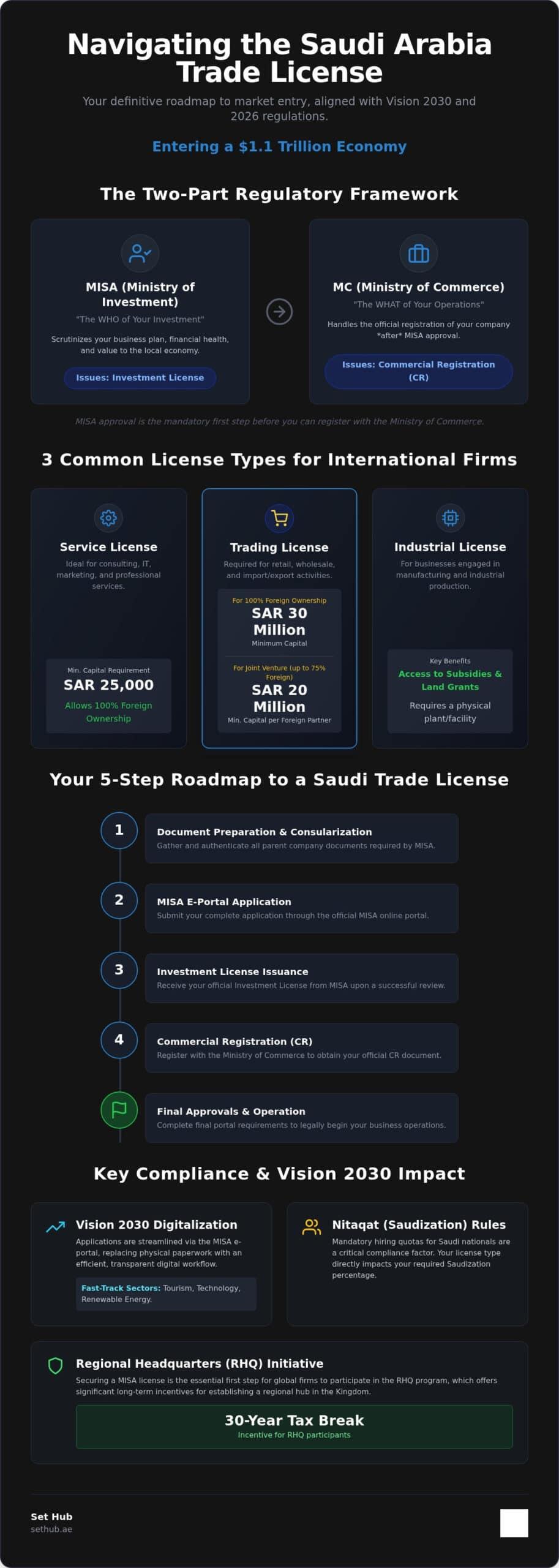
It’s helpful to view the setup process as a two-part conversation between two distinct government bodies. MISA represents the ‘Who’ of your investment. They scrutinize your parent company’s history, your financial health, and your long-term business plan. Their primary goal is to ensure that every foreign investor brings tangible value to the local economy.
The Ministry of Commerce (MC) handles the ‘What.’ Once MISA approves your presence, the MC issues your Commercial Registration (CR). This document serves as your official operating ID card. You can’t obtain a CR without a MISA license first. This sequence ensures your business is both vetted as an investor and registered as a legal trader. It’s a collaborative regulatory framework designed to provide peace of mind for both the government and the entrepreneur.
The Impact of Vision 2030 on Licensing
The 2026 licensing landscape reflects the peak of the Vision 2030 digital transformation. Applications that once took months are now processed through the MISA e-portal with remarkable efficiency. This system has removed the friction of physical paperwork, replacing it with a transparent, data-driven workflow that keeps you informed at every stage.
Specific sectors now enjoy targeted fast-track paths. If your business operates in tourism, technology, or renewable energy, you’ll find the process is specifically tailored to your industry’s needs. The Investment License is the golden ticket to Saudi market entry in 2026, providing the legal foundation to scale within the region’s most ambitious economy. By simplifying these administrative milestones, the Kingdom has transformed a complex hurdle into a series of predictable, manageable checkboxes.
The 8 Primary Types of Business Licenses in KSA
Avoid future operational restrictions by selecting the correct license category from the start. In 2026, Saudi Arabia’s Ministry of Investment utilizes the International Standard Industrial Classification (ISIC4) to organize business activities. This alignment ensures your venture matches global standards while providing a clear framework for local compliance. Each category carries distinct minimum capital requirements and specific Saudization quotas that directly impact your overhead and hiring flexibility. Choosing the wrong path can lead to administrative friction or delays in obtaining your Commercial Registration.
Service, Trading, and Industrial Licenses
These three categories represent the most common entry points for international firms. They offer different levels of ownership and require varying levels of initial investment:
- Service License: This is the preferred choice for consulting, IT, and marketing agencies. It allows for 100% foreign ownership and features a low minimum capital requirement of SAR 25,000 for most service-based models.
- Trading License: If your business involves retail or wholesale, this is the required path. It carries higher entry barriers. For 100% foreign ownership in retail, the capital requirement is SAR 30 million. If you opt for a joint venture with a Saudi partner (capped at 75% foreign ownership), each foreign investor must contribute a minimum of SAR 20 million.
- Industrial License: Reserved for manufacturing, this license unlocks the Kingdom’s most robust incentives. While it requires a physical plant and specific infrastructure, it provides access to utility subsidies and industrial land grants.
Specialized Licenses: Entrepreneurial to Mining
The Kingdom’s vision extends into niche sectors with high growth potential. These specialized paths cater to specific business models and professional expertise:
- Entrepreneurial License: This provides a low-cost entry point for VC-backed startups. It’s designed to attract innovation and talent with simplified documentation.
- Professional License: This is for licensed professionals, such as engineers or architects, who wish to provide their services directly under their own name.
- Mining and Agricultural Licenses: While these have high entry barriers and complex environmental regulations, they offer strategic access to the Kingdom’s vast natural resources and food security initiatives.
Securing the right saudi arabia trade license requires a deep understanding of how these categories interact with Nitaqat hiring rules. It’s about finding the perfect balance between your business goals and the current regulatory landscape. You can use a business setup cost calculator to see how these different license types and capital requirements will influence your initial launch budget.
How to Obtain Your Saudi Trade License: 5 Steps
The path to your Saudi market entry is a structured sequence of milestones designed to ensure your business is compliant from day one. In 2026, the process is faster and more digital than ever, but it still requires meticulous attention to detail. Skipping a single attestation or misidentifying a business activity can result in avoidable delays. By following this roadmap, you can move from initial planning to active operations with minimal friction. Securing your saudi arabia trade license is the primary hurdle, followed by the formal registration of your legal entity.
Step 1: Document Legalization and Pre-Approval
Start by consularizing your parent company documents in your home country. This is the foundation of your application. You’ll need to secure attestation from both the Saudi Embassy and your local Ministry of Foreign Affairs (MOFA). These verified documents prove your company’s legal standing and financial history to Saudi regulators. During this phase, you must also draft your Articles of Association (AOA) to align specifically with KSA standards. It’s also the time to identify your ‘General Manager’ for the Saudi entity. This individual will be the face of your company in local government dealings, so choosing them early simplifies the rest of the paperwork.
Step 2: Navigating the MISA Portal and CR
Submitting your application via the Invest Saudi portal requires precision. To avoid common rejection triggers, ensure your business plan is comprehensive and your financial statements are up to date. Inconsistencies between your parent company’s activities and your proposed Saudi operations are the most frequent causes of delay. In 2026, you can expect a processing timeline of 1-2 weeks for the MISA license and an additional 3-5 days for the Commercial Registration (CR). The CR is the final document that grants your ‘Unified National Number’. This number is your primary identifier for all future government interactions, from taxes to employee visas.
Once you hold both the MISA license and the CR, you’ve reached the point of legal existence. However, your setup isn’t complete until you handle the essential post-licensing tasks. You must register with the Zakat, Tax and Customs Authority (ZATCA) for VAT and corporate tax. Simultaneously, you’ll need to initiate your corporate bank account opening. While the saudi arabia trade license gives you the right to invest, these final steps give you the practical tools to trade, hire, and grow. Every administrative milestone you pass is a simple checkbox on the path to your larger goal of regional expansion.
Key Requirements and Compliance Pitfalls
Maintaining a saudi arabia trade license is as much about ongoing compliance as it is about the initial application. While the Kingdom has simplified entry, the regulatory environment for established entities remains rigorous. You must navigate specific capital thresholds and labor quotas to keep your operations running without interruption. Understanding these requirements early prevents administrative friction and ensures your business remains in good standing with the Ministry of Investment and the Ministry of Commerce.
Understanding Minimum Capital Requirements
Capital requirements vary significantly based on your chosen business activity. Service licenses remain the most accessible route for SMEs and consulting firms. With a minimum capital requirement of just SAR 25,000 for most service models, they offer a low-friction entry point for IT and marketing agencies. This allows for 100% foreign ownership without the heavy financial burden associated with physical goods.
Trading licenses involve much higher hurdles. Some specialized trading models require capital commitments of up to SAR 26.6 million. If you aim for 100% foreign ownership in the retail sector, the requirement is SAR 30 million. For joint ventures with a Saudi partner, foreign ownership is capped at 75%, and each foreign investor must commit at least SAR 20 million. You should compare these figures to the cost of setting up a business in Dubai to determine which market aligns best with your current investment capacity.
Saudization and Labor Law Compliance
Labor compliance in 2026 centers on the Nitaqat program. This system categorizes your business into color zones based on your ratio of Saudi employees. Aim to maintain a ‘Green’ or ‘Platinum’ status from day one. High-status businesses enjoy faster visa processing and fewer restrictions on hiring international talent. You’ll manage these requirements through the Qiwa and Mudad platforms, which are the Kingdom’s primary digital tools for contract authentication and payroll compliance.
Physical presence is also a non-negotiable requirement. Your company must have a registered commercial address in KSA to remain compliant. Virtual offices are generally not sufficient for MISA-licensed entities. Additionally, securing a ‘Manager Visa’ for your lead representative is a critical early step. This individual acts as the authorized signatory for your Saudi entity, bridging the gap between your international parent company and local government bodies. If you’re ready to ensure your setup meets every 2026 mandate, contact our KSA setup team for a detailed compliance review.
Launch Your Saudi Business with Set Hub
Expanding into a new market is a milestone that should be defined by growth, not administrative friction. While the steps to secure a saudi arabia trade license are now clearer, managing the minute details of MISA and Ministry of Commerce protocols requires local precision. Set Hub acts as your seasoned navigator, leveraging over 15 years of Middle Eastern expertise to turn complex regulatory requirements into a series of simple, managed checkboxes. We don’t just provide a service; we act as your strategic partner for regional expansion.
Our team handles the entire end-to-end process. This includes the initial MISA application, the issuance of your Commercial Registration, and the essential post-licensing tasks that often prove the most challenging. You’ll gain immediate access to our established network of local KSA partners and premium office space solutions. We also provide comprehensive support for corporate bank account opening and ZATCA VAT registration, ensuring your business is fully operational and compliant from day one.
Why UAE Companies Choose Set Hub for KSA Entry
Many of the most successful expansions into the Kingdom originate from the UAE. We specialize in the seamless transfer of documentation from UAE Mainland and Free Zones to the Saudi market. If you’re currently evaluating your options, you might first explore Free Zone registration in the UAE as a strategic stepping stone. Our consultants possess a deep, dual-market understanding of both the Dubai and Riyadh regulatory landscapes, allowing us to anticipate challenges before they arise.
Contact Us for a Frictionless Setup
Your journey toward a successful Saudi presence begins with a clear, data-driven strategy. We invite you to book a consultation where we’ll help you determine the ideal KSA license type for your specific goals. Our team will provide a customized cost breakdown using our business setup cost calculator, ensuring you have full visibility into your investment from the start. Don’t let the complexity of new 2026 mandates slow your momentum. Start your Saudi Arabia expansion journey with Set Hub today and experience a truly frictionless market entry.
Your Future in the Kingdom Awaits
Securing a saudi arabia trade license is the first step toward accessing one of the world’s most dynamic economies. You’ve learned how selecting the correct ISIC4 category and meeting the 2026 capital requirements can transform a complex regulatory hurdle into a clear path for growth. Success in the Kingdom depends on navigating these administrative milestones with precision and foresight. By aligning with the Vision 2030 framework now, you’re positioning your business for decades of regional leadership.
We’ve helped over 10,000 entrepreneurs find their footing in the Middle East since 2009. With 15+ years of regional expertise, our team provides end-to-end MISA and CR management to ensure your entry is entirely frictionless. You don’t have to manage the shifting landscape of Saudization and local attestations alone. Secure your Saudi Arabia trade license with Set Hub’s expert consultants and focus on what you do best: building your business. The Kingdom’s $1.1 trillion economy is ready for your innovation, and we’re ready to help you lead the way.
Frequently Asked Questions
Can a foreigner own 100% of a business in Saudi Arabia in 2026?
Yes, foreign investors can enjoy 100% ownership in the majority of economic sectors as of 2026. This is a core pillar of the new Investment Law designed to equalize treatment between local and international capital. Some strategic areas like oil and military industries remain restricted. You’ll find that service and industrial categories are the most common paths for full foreign control.
How much does a Saudi trade license cost for a foreign investor?
While specific government application fees depend on your business activity, annual renewal fees for a saudi arabia trade license begin at SAR 2,000. You should also account for sector-specific subscriptions and Chamber of Commerce fees. These costs are part of a transparent fee structure designed to provide predictable overhead for international firms.
How long does it take to get a trade license in Saudi Arabia?
You can expect the MISA investment license to be issued within 1 to 2 weeks through the digital portal. Once that’s secured, obtaining your Commercial Registration from the Ministry of Commerce typically takes an additional 3 to 5 days. The Kingdom’s digital transformation has significantly reduced what used to be a month-long process.
Is a local Saudi partner required for a trading license?
A local partner isn’t strictly required, but your choice depends on your capital capacity. You can own 100% of a retail business if you meet the SAR 30 million capital requirement. If you opt for a joint venture, foreign ownership is capped at 75%, and each foreign partner must invest a minimum of SAR 20 million.
What is the difference between a MISA license and Commercial Registration (CR)?
The MISA license is your entry permit as a foreign investor, while the Commercial Registration (CR) is your actual operating permit. Think of the MISA license as the “Who” that authorizes your presence in the Kingdom. The CR is the “What” that allows you to hire staff, open bank accounts, and sign local contracts.
Can I use my UAE trade license to operate in Saudi Arabia?
No, you cannot operate directly using a UAE license. You must apply for a specific saudi arabia trade license to trade legally within the Kingdom. However, if you’re expanding from the UAE, the process of consularizing and transferring your parent company documents is highly efficient. This makes the cross-border transition feel routine rather than a fresh hurdle.
What is the minimum capital for a service license in KSA?
The minimum capital for a service-based Limited Liability Company (LLC) is SAR 25,000. This low entry barrier makes the service license the most accessible route for consulting, IT, and marketing firms. It’s an ideal choice for SMEs looking to establish a footprint without the massive capital commitments required for retail or manufacturing.
Do I need a physical office in Saudi Arabia to get a license?
Yes, you must have a registered commercial address in Saudi Arabia to finalize your setup. Regulators require a physical lease to ensure your business has a legitimate base of operations. While virtual options are common in other regions, they generally don’t meet the compliance standards for MISA-licensed foreign entities in 2026.
Need help with this? Set Hub’s consultants can help with company formation in Saudi Arabia. Book a consultation to get started.